
REVIEW · FOOD & DRINK
Absolute Osaka Food Tour
Neon Osaka tastes better with a guide. This 3-hour street food walk ties together Dotonbori energy, quieter alley lanes, and time at a secret shrine area tucked away from the main crush. You also get insider stories that turn what you see into something you understand.
I like how the tour is built around four food stops, including Osaka classics like takoyaki and kushikatsu. I also like the guide angle, with real local context such as the Glico man story linked to Filipino sprinter Fortunato Catalon, plus route choices designed to reduce the endless queue effect around the most famous sights.
One consideration: it’s not recommended for gluten-free eaters. If that’s you, plan to use a different food plan and confirm needs before you book.
In This Review
- Key things to know before you go
- Dotonbori at 5:00 pm, when Osaka food feels like a show
- The guide matters, from Asli to Melissa to Marie
- Stop 1: Glico Sign and the Fortunato Catalon story
- Stop 2: Dotonbori District, learning how to avoid the worst queues
- Stop 3: Minami (Namba) street food focus
- Hozenji Yokocho: quieter lanes, a break from main-street noise
- Sennichimae Doguyasuji Shotengai: shopping arcade energy, food in context
- Kuromon Market: the classic Osaka tasting ground
- Misono Building: a final dose of Osaka texture before you head out
- What you actually eat: takoyaki, kushikatsu, plus changes by season
- Drinks, dessert, and dietary realities (vegetarian yes, gluten-free no)
- How much value is $231 for a 3-hour food walk?
- Who should book this Osaka food tour, and who should skip it
- Weather and pacing: Osaka works best when you can walk
- Should you book Absolute Osaka Food Tour?
- FAQ
- How much is the Absolute Osaka Food Tour?
- How long is the tour, and when does it start?
- Where do I meet, and where does the tour end?
- What is included in the food and drink?
- Is the tour family-friendly, and is there an alcohol age limit?
- What if the weather is bad or I need to cancel?
Key things to know before you go
- 4 food stops plus dessert, so you are not just sightseeing and snacking randomly
- 1 drink included, with a minimum drinking age of 21
- Small group size (maximum of 10), which makes it easier to hear your guide and move at a human pace
- Route that avoids the worst tourist lines, swapping the biggest storefront chaos for side lanes and quieter pockets
- A shrine stop away from the main street flow, which helps balance all that bright Dotonbori energy
- Vegetarian and pescetarian friendly, but gluten-free is not recommended
Still weighing up options in Osaka? These are the ones our reviewers rated highest.
- Osaka Go Karting Tour with Funny Costume
★ 5.0 · 2,658 reviews - Osaka Castle: Museum and Tower Entry Ticket
★ 4.5 · 2,380 reviews - Osaka: Shinsekai Food Tour with 13-15 Dishes at 5 Eateries
★ 4.8 · 2,204 reviews - Osaka Food Tour: 13 Dishes at 5 Local Eateries
★ 5.0 · 2,149 reviews
Dotonbori at 5:00 pm, when Osaka food feels like a show
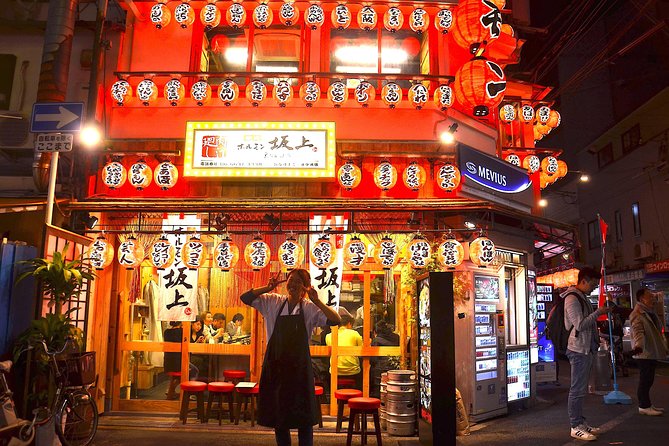
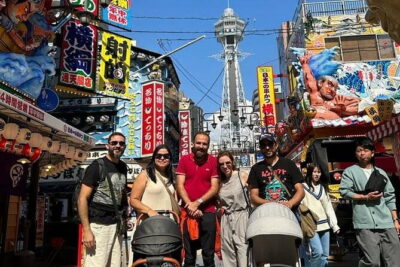
The tour starts at 5:00 pm in the Dotonbori area, right where the neon is loud and the streets feel busy. If you arrive a few minutes early, you can get your bearings fast before the group settles in. The meeting point is on Dotonbori, in the Chuo Ward area, and the walk later leads you toward Sennichimae as the ending point.
This is a smart time slot. Late afternoon into early evening is when street food scenes in Osaka feel most alive, and your stomach is awake enough to enjoy multiple bites. You’re also walking in the part of the day when it’s easier to spot the energy that makes Dotonbori famous.
The guide matters, from Asli to Melissa to Marie
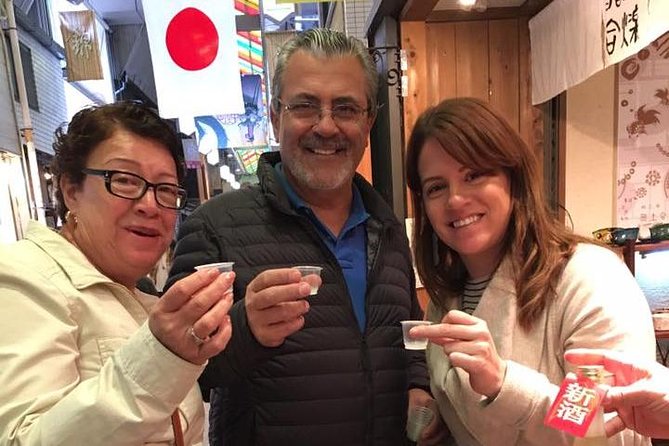
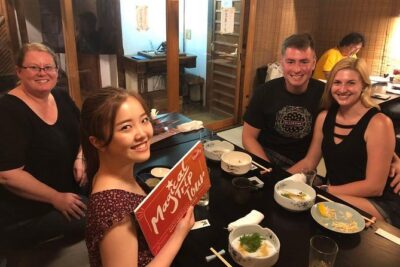
This tour runs with a local English-speaking guide, and the biggest value is how the guide connects food to place. You don’t just get a list of what to order. You get the why behind the choices and the small cultural details that help you read Osaka like a local instead of a passing audience.
From the guide names that come up in bookings, you might meet people such as Asli, Melissa, or Marie. Your exact guide can vary, but the goal stays consistent: help you taste well, and help you understand what you’re seeing while you walk.
And because the group is capped at 10 travelers, questions do not get steamrolled. That matters if you care about ingredient swaps, pacing, or simply wanting the guide to explain what to watch for at each stall.
Stop 1: Glico Sign and the Fortunato Catalon story
You begin at the Glico man area by the Dotombori Glico Sign. It’s a classic photo magnet, but the tour uses it as a story starter, linking the famous image to Filipino sprinter Fortunato Catalon and how he helped inspire a nation and a company.
This kind of stop does two things for you. First, it gives context early, so later stops feel connected rather than random. Second, it gives your eyes something to do besides hunting for the next sign or menu board.
It also sets the tone for how the tour works: short, purposeful stops that transition smoothly into eating.
- Osaka Go Karting Tour with Funny Costume★ 5.0 · 2,658 reviews
- Osaka Castle: Museum and Tower Entry Ticket★ 4.5 · 2,380 reviews
- Osaka: Shinsekai Food Tour with 13-15 Dishes at 5 Eateries★ 4.8 · 2,204 reviews
- Osaka Food Tour: 13 Dishes at 5 Local Eateries★ 5.0 · 2,149 reviews
- Hungry Osaka Street Food Tour:15 Tastings & 3 Drinks with a Local★ 5.0 · 1,727 reviews
Stop 2: Dotonbori District, learning how to avoid the worst queues
After that, you move through the Dotonbori District with a clear strategy. The area can feel similar to Tokyo’s Shibuya in terms of lights, sounds, and sheer attention grabbing. The downside is that the most famous restaurants can become overly commercial, with queues that drain your time.
This tour tries to steer you away from that. You get to experience the famous neon street mood, but you’re not stuck treating every stop like a line-standing test.
Practically, this is one of the reasons a guided food tour often beats DIY. Not because you cannot find food on your own, but because you do not want to gamble your meal time on trial and error when you only have a few hours.
Stop 3: Minami (Namba) street food focus
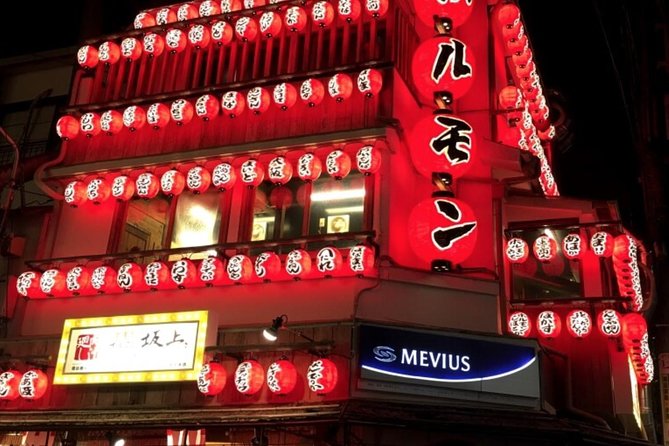
Next comes Minami (Namba), another core Osaka food area. The tour uses this segment to shift from neon landmark walking into what you actually came for: street food tastings.
You’ll want to keep your expectations simple here. This is a food-focused stroll, not a sit-down dinner with courses. Your guide paces the group so you can taste multiple items across the night without feeling like you’re constantly catching up.
If you’re the type who likes to nibble as you go, this part clicks. If you want one big meal, you might still enjoy it, but you’ll likely feel the tour works best when you accept multiple small tastes as the plan.
Hozenji Yokocho: quieter lanes, a break from main-street noise

Midway through, you head into Hozenji Yokocho. The main idea is simple: hidden alley walking and that off-the-main-street vibe where the crowd thins and the atmosphere feels more local.
This is also where the tour’s “secret shrine” promise begins to make sense. The experience is designed to include time at a quieter shrine area away from the busiest streets. That rhythm matters, because otherwise an Osaka food tour can feel like a nonstop hit of neon and noise.
You can think of this stop as your reset button. You get to slow down, walk through a smaller area, and prepare your appetite for the later market and snack-heavy portions.
Sennichimae Doguyasuji Shotengai: shopping arcade energy, food in context
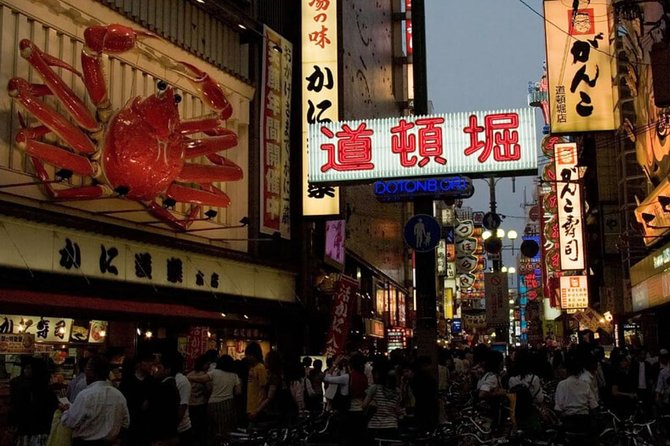
The route then leads you to Sennichimae Doguyasuji Shotengai, which is part of why this tour feels grounded. You’re not only eating. You’re also watching Osaka in everyday mode, where food is mixed into the flow of local errands and shopping.
Arcades and shopping lanes can be busy, but the key here is that you are moving with a guide who knows what the food stops are and how to time them. If you’ve ever gotten lost trying to follow a map while hungry, you’ll appreciate this.
Also, if you care about where things come from in Osaka, this kind of stop tends to help. The food is not floating in isolation. It’s tied to the places people actually walk through.
Kuromon Market: the classic Osaka tasting ground
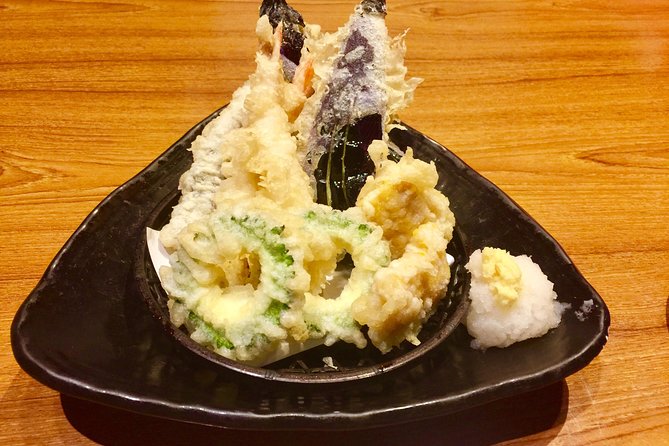
Next up is Kuromon Market, one of Osaka’s best-known food destinations. On this tour, it functions like a tasting anchor, where you can experience the market atmosphere as part of the structured food plan rather than trying to do it all on your own.
This is also where you will probably notice the tour’s approach to variety. Even though the exact items can change depending on season and availability, the overall promise stays consistent: you’ll try multiple local dishes across the night.
One practical tip for market-style eating: keep your trash habits simple. Snack packaging adds up fast when you do several tastings. If you bring a small bag for wrappers, you’ll thank yourself later.
Misono Building: a final dose of Osaka texture before you head out
The itinerary also includes Misono Building as part of the route. It’s the kind of location that helps the tour feel like a real walk through the city rather than hopping from one counter to another.
By the time you reach this segment, you’re usually deep into the “I get it now” stage. The neon streets stop being overwhelming and start feeling like a map you can read: landmark, lane, food stop, and story all stitched together.
And then, just like that, the tour ends in the Sennichimae area. That ending point is useful if you want to keep wandering afterward, especially if you’re staying somewhere nearby.
What you actually eat: takoyaki, kushikatsu, plus changes by season
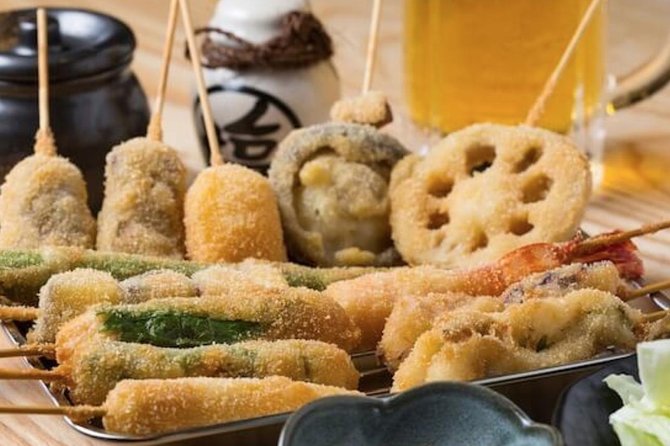
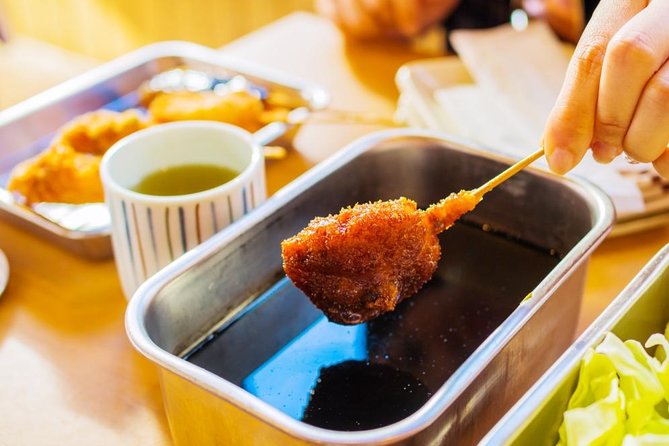
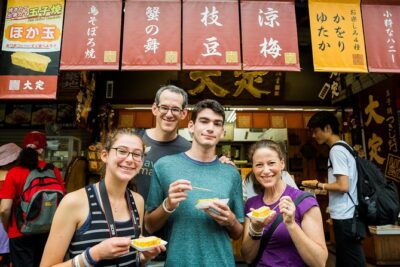
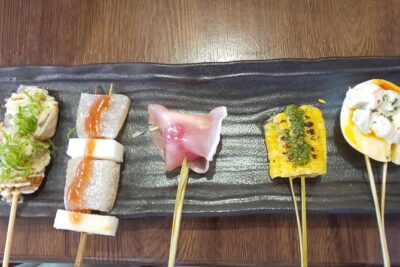
The tour overview highlights tasting Osaka’s street-food favorites, including takoyaki and kushikatsu skewers. Those two are a big part of why this tour works for first-time visitors: they’re unmistakably Osaka, and they’re easy to recognize even if you’ve never tried them.
You get local dishes at four food stops, plus one drink included and a traditional Japanese dessert. That mix covers salty bites and a sweet landing, so you don’t finish the tour feeling like you missed a “full meal” feeling.
Food changes are real on tours like this. The tour notes that dishes can shift based on season and restaurant availability. That’s not a problem, as long as you go in with the right mindset: you’re paying for a guided food route, not a promise that the menu board will match your expectations word-for-word.
Drinks, dessert, and dietary realities (vegetarian yes, gluten-free no)
This tour includes one drink, and it has a minimum drinking age of 21. If you’re under that age or you simply don’t drink alcohol, you can still enjoy the food and dessert, but you may need to plan on paying for any extra drinks you want.
On the dietary front, the tour is vegetarian and pescetarian friendly. One of the strongest parts of the experience is that a guide like Melissa is described as finding vegetarian options at each stop. That gives you real confidence if your party has plant-based eaters.
The flip side is clear: it’s not recommended for gluten-free. So if you need strict avoidance, do not rely on a casual swap. Ask questions before booking, and if the tour cannot meet your needs, choose another option designed specifically around gluten-free handling.
How much value is $231 for a 3-hour food walk?
At $231 per person for about 3 hours, this is not the cheapest way to eat in Osaka. But you are buying a specific kind of value.
You are paying for:
- Four structured food stops (not random sampling)
- A local English-speaking guide who explains what you’re eating and why
- One included drink and traditional Japanese dessert
- A route that aims to reduce the time lost to tourist-heavy queues near the most obvious storefronts
If you’re short on time, that matters. With only a few hours, a guided plan helps you turn a “nice food evening” into an “I tried the right things and learned the city” evening.
Also note the tour operates with a maximum of 10 travelers, so it doesn’t feel like you’re part of a moving bus. That small group detail is often where the real money goes, because it makes the experience more thoughtful and less scripted.
Who should book this Osaka food tour, and who should skip it
This tour fits best if you:
- want to focus on street food without spending mental energy on planning every stop
- like a mix of landmarks plus eating, from the Glico Sign area to Kuromon Market
- enjoy learning small stories while you walk, not only collecting photos
- have vegetarian or pescetarian needs in your group
Consider skipping or swapping for another option if you:
- need a gluten-free plan, since it’s not recommended
- prefer fully independent dining with zero structure
- want to do a very slow, sightseeing-first walk, since the pacing is built around food timing
The tour also asks for moderate physical fitness. It’s a walking experience, and while it’s family-friendly, you should be ready for several stops spread over about three hours.
Weather and pacing: Osaka works best when you can walk
The experience requires good weather. If it’s canceled due to poor conditions, you’ll be offered a different date or a full refund. This is important if you’re traveling during rainy months, or if your schedule is tight.
Also, the tour is offered with mobile tickets, and it’s described as having same-day booking available. That can be helpful when you wake up and decide you want street food tonight.
Should you book Absolute Osaka Food Tour?
I think you should book if your goal is to eat your way through Osaka in a way that feels guided, not random. You’ll get the classics like takoyaki and kushikatsu, you’ll taste across four stops, and you’ll also spend time in quieter lanes and a shrine area where the city tone shifts from headline-neon to local-paced.
If you need gluten-free care, I’d hesitate. The tour is not recommended for gluten-free, and with that dietary need, it’s better to choose a plan built around strict handling than to hope for adjustments.
For everyone else, this is the kind of tour that makes Osaka feel simpler fast. You walk in, follow the route, eat well, and leave with a mental map of where the food culture actually lives.
FAQ
How much is the Absolute Osaka Food Tour?
The price is listed as $231.00 per person.
How long is the tour, and when does it start?
The duration is about 3 hours, and the start time is 5:00 pm.
Where do I meet, and where does the tour end?
You meet at Dotonbori (Osaka, Chuo Ward, Dōtonbori) and the tour ends in the Sennichimae area (Chuo Ward, Osaka).
What is included in the food and drink?
You’ll try local dishes at 4 food stops, and you get 1 drink included and a traditional Japanese dessert.
Is the tour family-friendly, and is there an alcohol age limit?
Yes, it’s family-friendly, and the minimum drinking age is 21.
What if the weather is bad or I need to cancel?
The tour requires good weather. If it’s canceled due to poor weather, you’ll be offered a different date or a full refund. You can cancel for a full refund if you cancel at least 24 hours in advance of the start time.
Newest Osaka write-ups from the Loving Japan desk


Food & Drink, side by side.
 ★ 5.0Shinjuku Food Tour (13 Dishes at 4 Local Eateries)From $866,603 reviews
 ★ 5.0Tokyo Tsukiji Fish Market Food and Culture Walking TourFrom $993,184 reviews
 ★ 4.8Shinsekai Food Tour with 13-15 Dishes at 5 EateriesFrom $532,204 reviews
 ★ 5.0Osaka Food Tour: 13 Dishes at 5 Local EateriesFrom $732,149 reviews
 ★ 4.9Shinjuku Food Tour (15 Dishes and 4 Eateries)From $852,033 reviews
 ★ 5.0Kyoto Night Foodie Tour in Gion (9+ dishes + 6 Sake tastings)From $1631,762 reviews
 ★ 5.0Hungry Osaka Street Food Tour:15 Tastings & 3 Drinks with a LocalFrom $731,727 reviews
 ★ 5.0Tsukiji Fish Market Food and Walking tourFrom $301,724 reviews
Filed on these lists too