
REVIEW · FULL-DAY
Full-Day Accessible Tour of Tokyo for Wheelchair Users
Tokyo is easier with the right route. This wheelchair-friendly full-day tour links major sights with train tickets included and gives you hotel pickup across Tokyo’s 23 wards. You get a smooth path through Asakusa, Shibuya, and Meiji Jingu, with enough time to ask questions and adjust as you go.
I like that the pacing is flexible. I also like that the guide helps you handle Tokyo’s train system and crowded areas without you having to brute-force it with a map app and hope.
One consideration: food and drinks are not included, so you’ll want to plan for a real meal break on your own.
In This Review
- Key highlights worth packing for
- Why this wheelchair-friendly Tokyo loop feels easier than DIY
- Price and value of a private day with pickup and train tickets
- Starting in Asakusa: the Kengo Kuma tourist center makes a smart launch point
- Asakusa essentials: Thunder Gate, Nakamise Street, and Senso-ji without the stress
- Sumida Park along the river: Skytree views and a needed reset
- Shibuya Crossing and Cat Street: famous, loud, and best done with a guide
- Meiji Jingu Shrine and Omotesando: quiet tradition paired with fashion boulevard energy
- Trains, transfers, and pacing: what makes the logistics feel manageable
- What you should plan for: comfort, timing, and what to bring
- Should you book this accessible Tokyo tour?
- FAQ
- How long is the tour?
- What time does the tour start, and where does it end?
- What’s included in the price?
- Are food and drinks included?
- Is the tour private, and is there a minimum group size?
- Can I cancel for a full refund?
Key highlights worth packing for
- Wheelchair-focused route design for barrier-free sightseeing across multiple neighborhoods
- Train tickets included, so you spend less time figuring out connections
- Hotel pickup and drop-off within Tokyo’s 23 wards, which saves a lot of daily energy
- A private format with your group only, so your guide can match your pace
- A guide who stays on top of crowds, which matters a lot around Shibuya and Asakusa
- Big-name Tokyo stops plus classic shopping streets, without turning the day into a sprint
Still weighing up options in Tokyo? These are the ones our reviewers rated highest.
- Mt Fuji and Hakone 1-Day Bus Tour Return by Bullet Train
★ 5.0 · 26,383 reviews - 1-Day Tokyo Bus Tour
★ 5.0 · 14,250 reviews - Tokyo: teamLab Planets TOKYO Digital Art Museum Entry Ticket
★ 4.6 · 9,779 reviews - Mt Fuji & Hakone Cruise, Drum Show Bullet Train 1 Day from Tokyo
★ 4.0 · 7,413 reviews
Why this wheelchair-friendly Tokyo loop feels easier than DIY
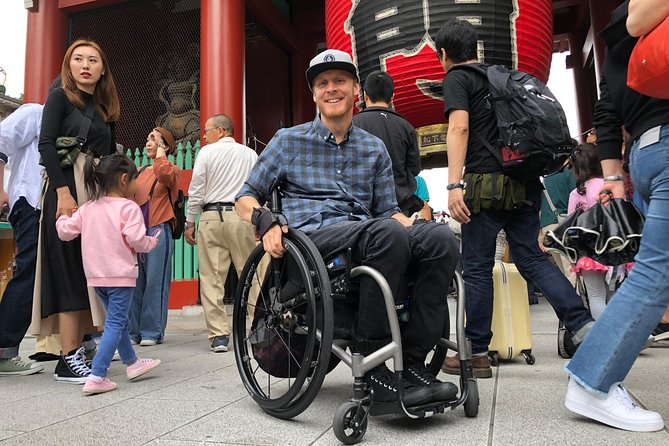
Tokyo is one of those cities that can be amazing and exhausting at the same time. The hardest part for a wheelchair user is often the “invisible friction”: stairs you cannot use, long detours, crowded walkways, and the stress of figuring out which train station exit actually works.
This tour is built to reduce that stress. You’re not just visiting sights, you’re following a route designed around wheelchair needs, with a professional guide next to you the whole time. You also get the practical benefit of going like a local: you ride trains as part of the plan, instead of treating transit as an afterthought.
And it is not only temples and shrines. The day also includes the sensory overload of Shibuya Crossing and the street energy of Shibuya and Omotesando. The best part is that you can slow down. That matters when your group includes different mobility levels, or when you want time to take photos without feeling pushed forward.
Price and value of a private day with pickup and train tickets
At $191.08 per person for about 7 hours, this is not a “cheap and cheerful” activity. But for what you get, it often looks like good value, especially if you want a private, wheelchair-friendly day without doing logistical heavy lifting.
Here is what your money supports:
- A professional guide for a full day
- Private tour time with your group only
- Train tickets included, which can be a major practical cost savings, but more importantly, it removes decision fatigue
- Hotel pickup and drop-off within Tokyo’s 23 wards, so you do not have to arrange multiple transfers on your own
- Access to free-admission stops like Senso-ji-related areas and other listed landmarks
Also, the tour offers group discounts, which can bring the per-person cost down if you’re traveling with multiple people or caregivers.
Where the price can feel less attractive is if you are only interested in one neighborhood, or if you are fully comfortable planning accessible routes yourself. But if you want one guide, one plan, and fewer “wait, can we get through here?” moments, this tends to pay off.
Starting in Asakusa: the Kengo Kuma tourist center makes a smart launch point
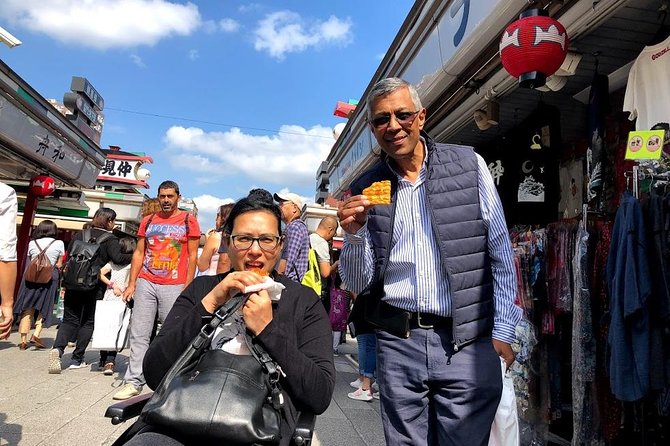
Your day begins at the Asakusa Culture Tourist Information Center, in Taito City, near Kaminarimon. That is a useful start because you are positioned right in the Asakusa action, and you have a clear place to gather at 9:30 am.
Stop one is the tourist center itself, an eight-story building designed by architect Kengo Kuma. It is listed as a sightseeing attraction, but the bigger value is what it does for your day: it helps you orient fast. When you are navigating in a wheelchair, knowing your direction early can save time later, especially before you hit the densest streets.
A quick 15-minute visit also sets the tone. Your guide can explain how the day will flow, then adjust the route based on your pace. You get a calmer start, instead of jumping immediately into the crowd.
- Mt Fuji and Hakone 1-Day Bus Tour Return by Bullet Train★ 5.0 · 26,383 reviews
- 1-Day Tokyo Bus Tour★ 5.0 · 14,250 reviews
- Tokyo: teamLab Planets TOKYO Digital Art Museum Entry Ticket★ 4.6 · 9,779 reviews
- Mt Fuji & Hakone Cruise, Drum Show Bullet Train 1 Day from Tokyo★ 4.0 · 7,413 reviews
- Tokyo: Shinjuku Food Tour (13 Dishes at 4 Local Eateries)★ 5.0 · 6,603 reviews
Asakusa essentials: Thunder Gate, Nakamise Street, and Senso-ji without the stress
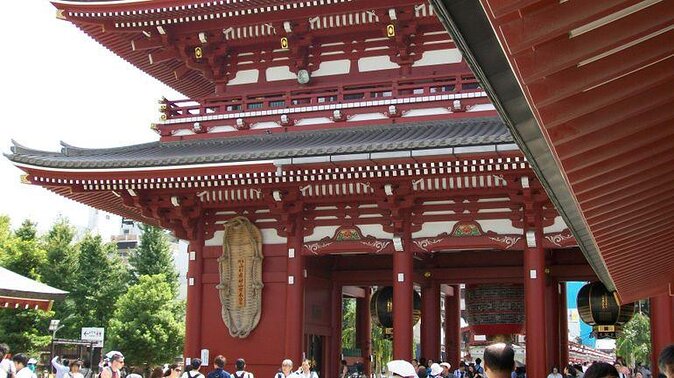
Next you move into the area around Kaminarimon, the Thunder Gate, and the Nakamise Shopping Street leading toward Senso-ji Temple. Nakamise is a famous shopping lane, and the practical thing to know is that it can feel packed. Your guide’s job here is not just history. It is also crowd navigation and helping you stay together.
You get about 20 minutes around Nakamise and the gate area, then 20 minutes at Senso-ji Temple (Asakusa Kannon Temple). Senso-ji is one of Tokyo’s most colorful and popular temples, which is exactly why it is worth seeing. It is also exactly why you need a plan if mobility is part of your day.
What I like about this segment is that it balances spectacle with breathing room. You are not stuck standing in one spot. You can look, take photos, and then move on when the crowd pressure gets high.
A small reality check: even when a route is designed for wheelchair users, some temple-adjacent areas can be busy. The difference here is that you are not left to figure it out alone. The guide keeps track of your group, so you are not doing the frantic “where is everyone” dance.
Sumida Park along the river: Skytree views and a needed reset
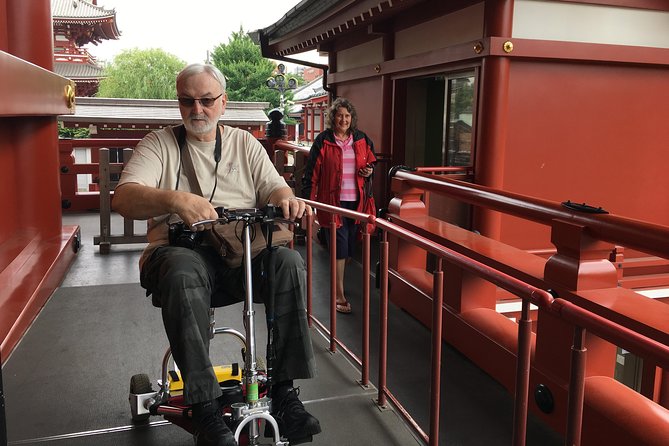
After Asakusa’s temple energy, you get a calmer pause at Sumida Park, near Asakusa Station along the Sumida River. It is one of those places where the scenery gives your body a breather, even if you are still on your feet in some way.
You’ll have about 15 minutes here, with views such as Tokyo Skytree in the distance. If you visit during cherry blossom season, this park area is especially scenic, but even outside spring it is a good contrast stop after busy streets.
For wheelchair users, a riverfront park stop can be a smart move because you often have more open sightlines and fewer bottlenecks than the central shopping lanes. It is also a natural transition point before you head toward Shibuya, which is where Tokyo gets loud and crowded fast.
Shibuya Crossing and Cat Street: famous, loud, and best done with a guide
Then comes the big one: Shibuya Crossing near Shibuya Station. The crossing is described as crossed by up to 500,000 people per day, and at peak times as many as 3,000 people can move on one green light. That is a lot of motion in one place, and it explains why having a guide matters.
You get about 20 minutes here. The value is timing and staying together through the scramble. When you have a wheelchair, the crossing can be doable, but the real challenge is managing the crowd flow and getting positioned safely.
From there you move to Shibuya Cat Street, a half-mile-long street between Harajuku and Shibuya. You get about 25 minutes. This area is more about vibe than monuments, and it is a great place to watch Tokyo street culture without committing to a long museum-style visit.
Cat Street is lined with stores that match the young fashion crowd. It can feel like a runway if your day includes that kind of energy. The drawback is that side areas can be tight. With a guide handling movement and timing, you can spend more time looking and less time negotiating space.
Meiji Jingu Shrine and Omotesando: quiet tradition paired with fashion boulevard energy
After the intensity of Shibuya, you shift to something more restful: Meiji Jingu Shrine. This stop gets the most time, about 50 minutes, which is a clue that the tour treats it like a real visit, not a quick photo stop.
Meiji Jingu is dedicated to the deified spirits of Emperor Meiji and his consort, Empress Shoken. It sits close to the busy JR Yamanote Line area near Harajuku, so you get an interesting contrast: high-traffic station life outside, shrine atmosphere inside.
This segment is a good match for wheelchair users because the longer time window lets you move at your own pace. You can take in the setting, pause when you need to, and ask questions about shrine culture, architecture differences, or what you are seeing around you.
Then you end with Omotesando, a sloping tree-lined boulevard in Tokyo’s Aoyama district. You get about 20 minutes. Omotesando often feels more stylish than historical, and it is one of the best places in Tokyo to connect the city’s traditions with modern design taste.
This combination works well as a finale. You start with temple intensity, pass through river calm, hit Shibuya’s rush, then finish with shrine quiet and a fashionable boulevard stroll. It’s a satisfying arc for a full day.
Trains, transfers, and pacing: what makes the logistics feel manageable
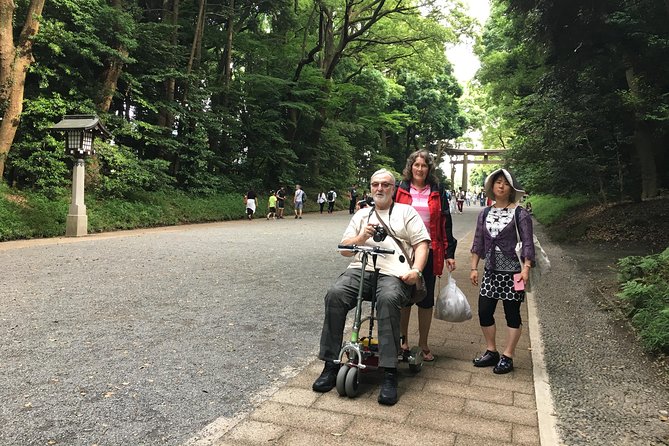
The biggest practical win is that trains are part of the plan and the train tickets are included. For a wheelchair user, that matters because train navigation is not just “getting on.” It is station layouts, ramps, and knowing where assistance is easiest.
The tour’s structure also helps: you can get pickup from anywhere within Tokyo’s 23 wards, and the day ends back at the meeting point. That means you do not have to coordinate separate arrival and departure plans on top of the sightseeing.
A lot of the day’s success comes down to how the guide manages movement in busy areas. Names like Machiko, Kaori, Fumiko, Emiko-san, Yumi, and Keita Mizuri show up in the feedback, and the common thread is clear: guides focus on making the day work for mobility needs, not forcing people to match the crowd.
One more detail that you should count on: station staff support. In Japan, many stations have staff that can help with ramps, and a competent guide can coordinate that moment so you are not scrambling. You still want to stay patient, because Tokyo is busy and schedules can be tight, but the setup here is designed to reduce surprises.
What you should plan for: comfort, timing, and what to bring
This is a 7-hour private day, and the tour is described as designed for wheelchair users with a moderate physical fitness level. That does not mean you will be moving non-stop, but you should expect enough time outdoors and between areas that you may want breaks.
Food and drinks are not included. That is not a dealbreaker, but it does change how you plan. If you have dietary needs or you need a predictable meal timing, you should plan on buying food during the day.
Also, you should plan for crowd levels. Asakusa and Shibuya are both popular, and the routes through shopping and major stations can be busy. The tour helps with timing and staying together, but comfort comes from preparation too.
If you use a wheelchair full-time, check that your chair is comfortable for longer rides and that you can manage transitions between street and station. If you use a rollator or a combo setup, you’ll still benefit, because the tour includes caregivers in the booking requirement.
Should you book this accessible Tokyo tour?
Book it if you want:
- A private, wheelchair-friendly day that hits major Tokyo landmarks across multiple neighborhoods
- Train tickets included plus hotel pickup and drop-off, so you can focus on sightseeing
- A guide who can adapt your pace in crowded areas like Asakusa and Shibuya
Skip it or think twice if:
- You prefer total independence and already know how you will plan accessible routes yourself
- You want a food-included tour, because you’ll handle meals separately
- Your group’s needs require a very custom ending time, since the tour finishes back at the meeting point
If your goal is a smooth, accessible first-rate Tokyo highlights day without the usual navigation headaches, this one is a strong pick.
FAQ
How long is the tour?
The tour is approximately 7 hours.
What time does the tour start, and where does it end?
It starts at 9:30 am and ends back at the meeting point (Asakusa Culture Tourist Information Center).
What’s included in the price?
The tour includes a professional guide, hotel pickup and drop-off within Tokyo’s 23 wards, private tour service, train tickets, and local taxes.
Are food and drinks included?
No. Food and drinks are not included.
Is the tour private, and is there a minimum group size?
It is a private tour, and there is a minimum of 2 people per booking, including caregivers.
Can I cancel for a full refund?
Yes. You can cancel for a full refund up to 24 hours in advance of the experience start time.
Newest Tokyo write-ups from the Loving Japan desk
Full-Day, side by side.
 ★ 4.5From Tokyo: Mount Fuji Full-Day Sightseeing TripFrom $684,970 reviews
 ★ 4.9Mount Fuji Full-Day Private Tour from Tokyo (Customizable)From $3931,470 reviews
 ★ 5.0Hiroshima / Miyajima Full-day Private Tour with Government Licensed GuideFrom $2021,298 reviews
 ★ 5.0Tokyo Private Full-Day Tour by Car or VanFrom $321684 reviews
 ★ 4.7From Tokyo: Must-Visit Mount Fuji Highlight Full-Day TourFrom $69532 reviews
 ★ 5.05 Top Highlights of Kyoto Full Day Bike Tour (E-bike option)From $172511 reviews
 ★ 5.0Full Day Biking Tour Exploring the Best of KyotoFrom $119498 reviews
 ★ 4.5Mt. Fuji, Hakone Full-Day Private Tour with English Driver GuideFrom $495458 reviews