
REVIEW · ASAKUSA, SENSO-JI AND TOKYO SKYTREE
Asakusa Night Evening Walking Tour with English-Speaking Guide
Night turns Asakusa into a whole new story. This small-group walk is built for the hour before dinner, when Kaminarimon Gate glows red and the streets feel calmer. I especially like the mix of big sights and real neighborhood corners, plus the way an English-speaking guide gives you backstory instead of just directions.
The only catch is the timing and pace, since you’re at each stop for a short window. If you’re hoping to linger inside, plan your expectations around short visits and the 6 PM closing for the main hall at Sensō-ji.
In This Review
- Key things to know before you go
- Why Asakusa at Night Feels Like a Tokyo Intro
- What You Pay (About $34) and Why It Feels Fair
- Meeting Near Kaminarimon and Ending on Hoppy Street
- Stop 1 and Stop 2: Kaminarimon Gate and Nakamise Street at Night
- Sensō-ji Temple: What You See When the Crowd Drops
- Asakusa Shrine, Hanayashikidori, and the Shift into Local Streets
- The Real Win: English-Speaking Guides Like Takumi and Mio
- Pace, Timing, and How to Make the Hour Work for You
- Who This Tour Suits Best (and Who Might Skip It)
- Should You Book This Asakusa Night Walk?
- FAQ
- How long is the Asakusa Night Evening Walking Tour?
- How much does the tour cost?
- What is included in the price?
- Is this tour small-group?
- Where does the tour start and end?
- Do I need to bring a printed ticket?
- What time should I consider for Sensō-ji?
- Can I cancel and get a refund?
- Is this tour suitable for most people?
Key things to know before you go
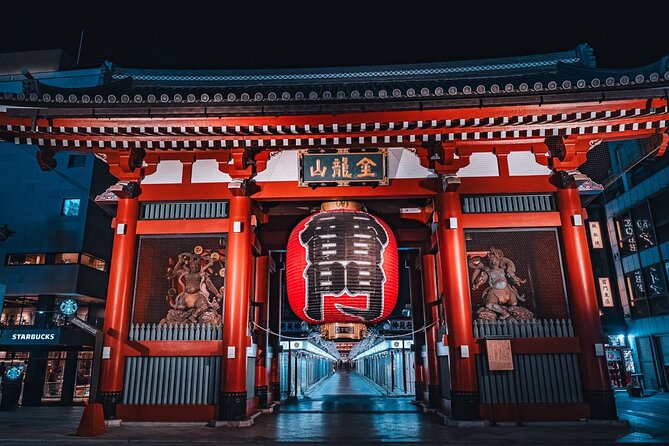
- Night lighting at Kaminarimon: Fujin and Raijin flank the gate, and that massive lantern is best seen after dark.
- Quieter temple time: Sensō-ji feels very different once the daytime crowd thins out.
- Snack street, minus the rush: You get a quick, useful walk along Nakamise without spending the whole evening shopping.
- Backstreet transition to izakayas: The route nudges you from temple areas to Hoppy Street for dinner.
- Small group, max 8 people: Easier questions, more personal attention, and less waiting around.
Still on the Sumida side? A few more Asakusa options
- Tokyo: Japanese Dance Cabaret Theater Asakusa-Kaguwa Ticket
★ 4.8 · 2,270 reviews - Tokyo: Meiji Shrine, Asakusa, Skytree Bus Tour and Cruise
★ 4.7 · 1,986 reviews - Tokyo: Roll and Authentic Sushi Making Class in Asakusa
★ 4.9 · 1,957 reviews - Tokyo: Asakusa Walking Tour with Sensoji Temple Visit
★ 4.8 · 1,583 reviews
Why Asakusa at Night Feels Like a Tokyo Intro
Asakusa at night works because it’s still central to Tokyo, but the mood changes fast when the sun goes down. You trade midday crowds for softer light, and the neighborhood turns into something closer to local routine. The walk is designed to be a practical first evening plan too, especially if you’re still figuring out trains and directions.
I like that the tour is tightly focused: you’re not trying to “see everything in one night.” Instead, you get a guided route that hits the places you’d recognize on day one, then connects them to the everyday streets around them. That mix matters because Asakusa isn’t only about photos, it’s about how the area feels to walk through after people settle down.
One more plus, the ending spot puts you in a good position for dinner. You’re not wandering hungry at the end, you’re dropped near izakayas and hoppy drink lanes, which makes it easy to keep moving without overthinking your plan.
What You Pay (About $34) and Why It Feels Fair
This tour costs $34.29 per person for about one hour, with an English-speaking guide. For the time, the price feels reasonable because most of what you’re paying for is the guidance and the structured flow between sights. Entrance fees at the stops are listed as free, so your money isn’t going mainly into ticketed attractions.
The value is also in the group size. With a maximum of 8 travelers, you’re less likely to get separated into a messy line, and your guide can answer questions without racing to stay on schedule. That matters when you want context, not just a stamp-and-go tour.
What you should budget beyond the tour is food and drinks. Food and drinks aren’t included, so you’ll be paying for your dinner on your own, and Asakusa can tempt you quickly. The upside is that the route naturally steers you toward places like Hoppy Street, so you can treat the tour as the start of your meal.
If you’re worried about value, think of this as an hour of “local meaning.” It helps you understand what you’re looking at and where to go next, without spending a big chunk of your evening.
Meeting Near Kaminarimon and Ending on Hoppy Street
You start near Burger King Asakusa Azumabashi, at the Kaminarimon area (the tour’s meeting point is a specific cross building address). I suggest you arrive a few minutes early and take 30 seconds to confirm your exact pickup spot on your map. In Tokyo, being even one or two blocks off can turn a smooth evening into a time sink.
The tour uses a mobile ticket, so keep your phone charged and ready. You’ll also want to have your confirmation handy when you book, since you receive it after booking.
At the end, the tour releases you at Hoppy Street. That’s not random. The walk is timed so you can transition directly into dinner, rather than heading back across town to find something. If you like a plan that reduces decision fatigue, this ending point is a smart move.
And because the tour is near public transportation, you can usually make your way before or after dinner without complicated transfers. Just keep an eye on the night timing, especially for the temple stop discussed next.
- Mt Fuji and Hakone 1-Day Bus Tour Return by Bullet Train★ 5.0 · 26,383 reviews
- 1-Day Tokyo Bus Tour★ 5.0 · 14,250 reviews
- Tokyo: teamLab Planets TOKYO Digital Art Museum Entry Ticket★ 4.6 · 9,779 reviews
- Mt Fuji & Hakone Cruise, Drum Show Bullet Train 1 Day from Tokyo★ 4.0 · 7,413 reviews
- Tokyo Mt Fuji 5th St & Hakone Cruise Bus Tour w/Bullet Train★ 4.4 · 5,024 reviews
Stop 1 and Stop 2: Kaminarimon Gate and Nakamise Street at Night
You begin at Kaminarimon Gate, the iconic entrance to Sensō-ji. The gate earns its fame for two reasons: it’s instantly recognizable, and it looks cinematic after dark. The red lantern is the star, but don’t skip the sides. You’ll find the statues of Fujin (wind) and Raijin (thunder), which is the kind of detail that turns a quick photo into something you actually understand.
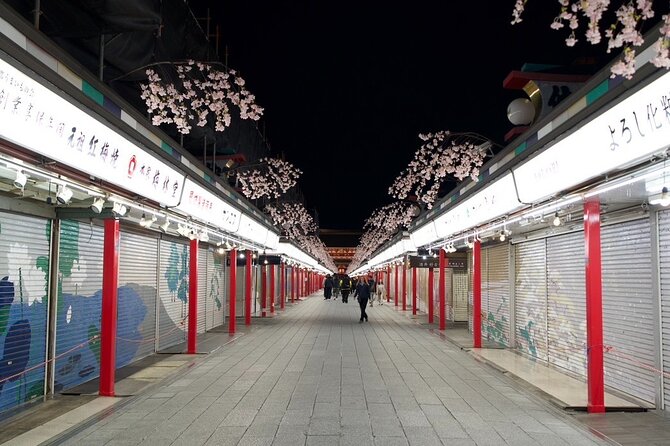
From there, the route continues along Nakamise Shopping Street near the gate. Daytime Nakamise is busy for a reason, but at night you get a more relaxed rhythm. You’ll pass shops selling traditional snacks and souvenirs, which is useful even if you do not plan to buy anything. It helps you see how the area is set up to serve pilgrims and visitors.
A practical tip: if you want a snack, consider buying one here or planning what you want before the temple crowds fully clear. Since your time is short at each stop, decide quickly, or you’ll be stuck browsing when the group moves on.
The main drawback at these early stops is simple: you don’t have long to linger. This is a walking tour, not a shopping tour. If you’re hoping for a slow wander with lots of time to browse, you may want to schedule temple time on a separate night or come back again after your guided hour ends.
Sensō-ji Temple: What You See When the Crowd Drops
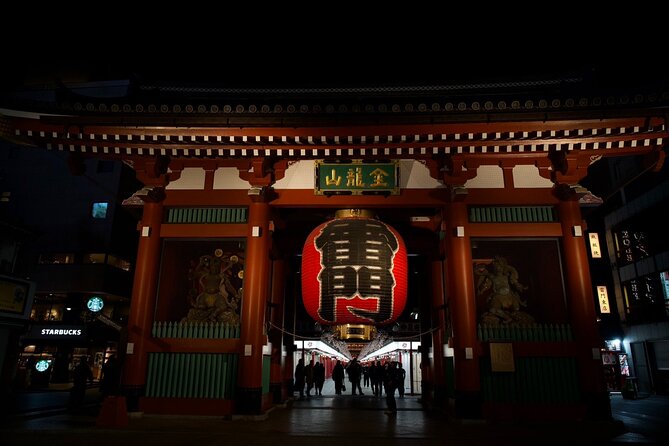
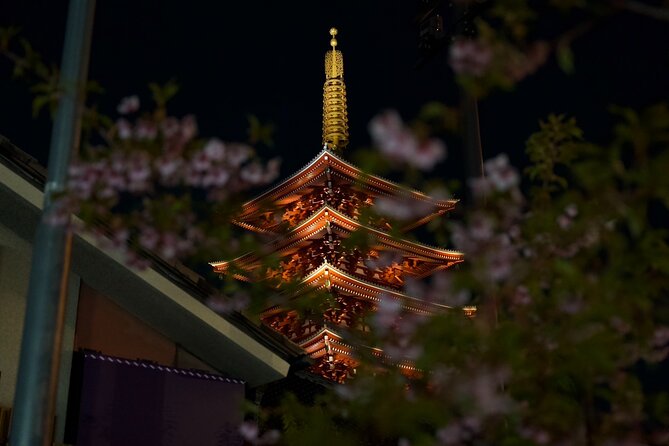
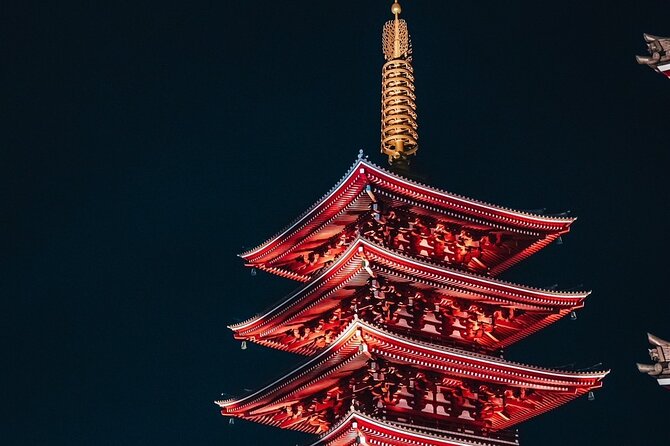
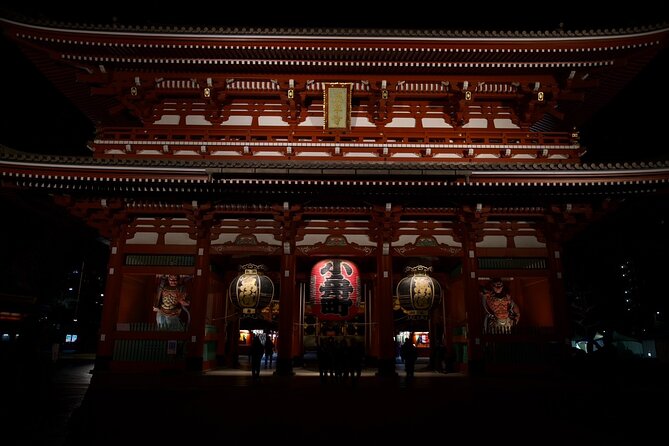
Next is Sensō-ji Temple, one of Tokyo’s best-known temples and a place many people visit in daylight. The night version hits differently because you’re not fighting the busiest hours. Instead, you get a calmer sense of space, and it’s easier to notice architectural details and the flow of people.
Sensō-ji is dedicated to Kannon, the goddess of mercy. That single fact gives you a lens for the whole area, so it doesn’t feel like you’re just looking at a famous gate. A guide’s job here is to turn symbols into meaning, and this tour is built for that.
Timing is the key consideration. The main hall closes at 6 PM, so depending on when your tour runs, you might have limitations on where you can enter or linger. Even if entry is restricted, you can still appreciate the setting and the feeling of the grounds at night.
What I like about doing Sensō-ji on this guided route is that you connect the dots. You’re already at Kaminarimon, you’ve walked Nakamise, and then you step into the temple area with the story in place. That helps your first-time visit feel more coherent.
If you’re the type who wants to sit quietly and pray or take your time, this tour may feel too quick. But if you want context and a smooth start to your Asakusa evening, it’s a strong approach.
Asakusa Shrine, Hanayashikidori, and the Shift into Local Streets
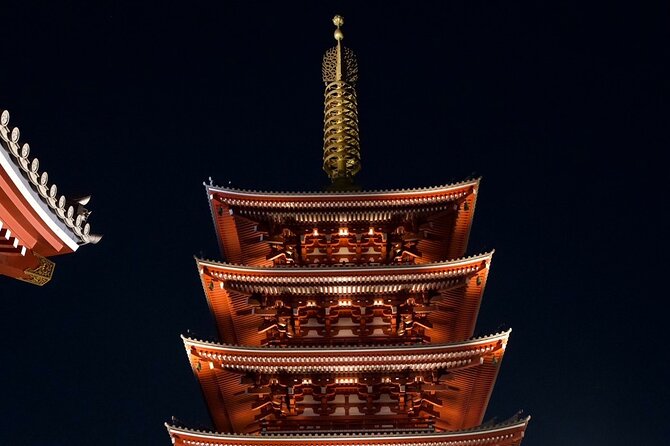
After Sensō-ji, the walk continues to Asakusa Shrine, located next to Sensō-ji. This shrine is dedicated to the three men who founded Sensō-ji. It’s also notable for its survival story: it was built in the 17th century and endured World War II, which gives the area an extra layer of meaning.
This stop tends to work well in a short window because the guide can explain why the shrine matters, so you’re not left guessing what you’re seeing. The result is that even a quick visit feels purposeful.
From there you move to Hanayashikidori, a street in the area named after Hanayashiki, Japan’s oldest amusement park. You’ll see shops, restaurants, and cafés mixed into the temple neighborhood. That mix matters. It shows you Asakusa isn’t frozen in time, it’s a living district where visitors and locals overlap.
Then you transition to Hoppy Street, which is lined with izakayas. These are Japanese pubs, and the street is known for serving hoppy, a popular local drink. This is where the mood changes again. You stop thinking in sightseeing mode and start thinking dinner and people-watching.
If you prefer a night plan that feels local instead of staged, the shrine-to-cafés-to-izakayas flow is a good one. It helps you understand the geography of Asakusa, so you can keep exploring after the tour ends.
The Real Win: English-Speaking Guides Like Takumi and Mio
The biggest strength of this experience is the human part: an English-speaking guide who tells stories that actually help you see what’s in front of you. I’ve seen how guides like Takumi and Mio can make a brief visit feel much more useful, especially if you already came in during the day but felt like you missed the context.
Mio’s style stands out for being energetic and friendly, with explanations that turn famous places into understandable symbols. Takumi’s approach works when you want the “what am I looking at and why does it matter” version of Tokyo. Both kinds of guides help you avoid the common first-timer trap: taking photos but not knowing what those details mean.
In a one-hour format, this is crucial. You don’t have time to wander aimlessly, so the guide’s direction becomes the difference between seeing sights and understanding them.
Ask questions if your guide offers opportunities. Even simple questions, like what a gate figure represents or why a shrine survived, can change how you remember the walk.
Pace, Timing, and How to Make the Hour Work for You
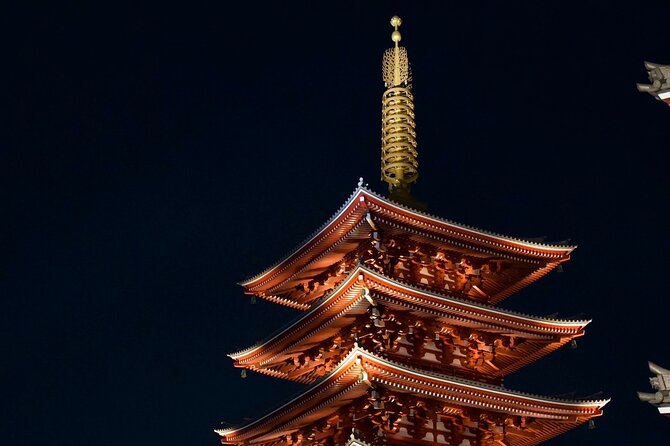
Because each stop is brief, the tour is best for travelers who want structure. Expect short photo moments, quick explanation blocks, and walking that keeps you moving. If you like to read every sign for 20 minutes, you might feel rushed. If you like to understand the highlights fast, you’ll likely enjoy it.
Also, think about your evening schedule. Sensō-ji’s main hall closes at 6 PM, so you want to align your plans so you still get the temple experience you want. If you’re going earlier, you might have more options. If you’re going later, you’ll still get the atmosphere and guidance, just with fewer entry possibilities.
This tour is also a good “pre-dinner” plan because it avoids overstuffing your evening. You get a cultural starter, then you’re released into a place built for food and drinks. That’s a nicer way to travel than arriving at dinner time with no clue where you want to eat.
Finally, the tour is capped at 8 people, which usually keeps the group manageable. That matters for listening quality. You’re not trying to hear over a huge crowd while also staying close enough to the front.
Who This Tour Suits Best (and Who Might Skip It)
This Asakusa night walk is a strong fit if you:
- are new to Tokyo and want your first Asakusa evening to feel organized
- already visited by day and want context for what you saw
- want an easy start toward dinner without planning every step
It may be less ideal if you:
- want long temple time, long shopping time, or slow wandering
- are traveling with a strict schedule that cannot flex around the 6 PM main hall closing
- hate group walking and prefer fully self-guided exploring
Most travelers can participate, and the tour is near public transportation, so it’s generally approachable. If you like small group tours that prioritize meaning, this one fits.
Should You Book This Asakusa Night Walk?
Book it if you want a guided hour that connects the big Asakusa landmarks to the local streets around them. For the price, you’re getting an English-speaking guide, a tight route, and a finish at Hoppy Street where dinner is the next natural step. It’s a practical way to get your bearings and understand what you’re looking at, without spending the whole evening on logistics.
Skip or adjust your expectations if you’re hoping for deep, slow time in the temple halls or a long shopping session. This is about highlights plus context, not a stay-all-night experience.
If you can, try to plan your evening with the 6 PM Sensō-ji main hall in mind. Then you’ll leave with both photos and real understanding, and you’ll already be standing where dinner is waiting.
FAQ
How long is the Asakusa Night Evening Walking Tour?
It’s approximately 1 hour.
How much does the tour cost?
The price is $34.29 per person.
What is included in the price?
An English-speaking guide is included. Admission is listed as free for the stops, and food and drinks are not included.
Is this tour small-group?
Yes. The maximum group size is 8 travelers.
Where does the tour start and end?
It starts at Burger King Asakusa Azumabashi in Kaminarimon, and it ends at Hoppy Street in Asakusa.
Do I need to bring a printed ticket?
No. You use a mobile ticket.
What time should I consider for Sensō-ji?
The main hall at Sensō-ji closes at 6 PM, so entry may be limited depending on your tour time.
Can I cancel and get a refund?
Yes, free cancellation is available up to 24 hours in advance for a full refund.
Is this tour suitable for most people?
The information provided says most travelers can participate.
Asakusa and the Skytree, Keep Going



Newest Tokyo write-ups from the Loving Japan desk






Asakusa, Senso-ji and Tokyo Skytree, side by side.
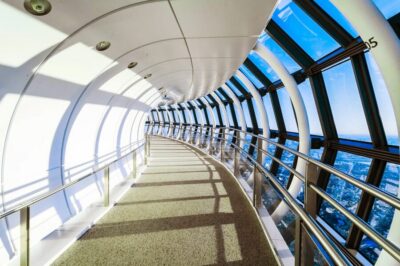 ★ 4.5TOKYO SKYTREE® Admission ticketFrom $1311,192 reviews
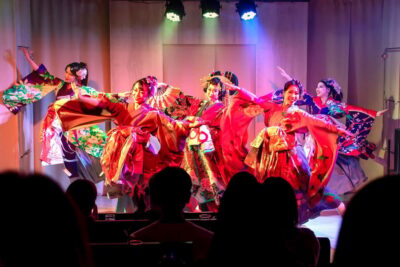 ★ 4.8Japanese Dance Cabaret Theater Asakusa-Kaguwa TicketFrom $492,270 reviews
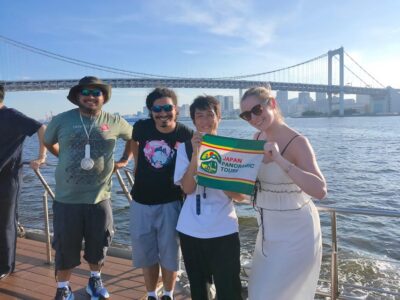 ★ 4.7Meiji Shrine, Asakusa, Skytree Bus Tour and CruiseFrom $1221,986 reviews
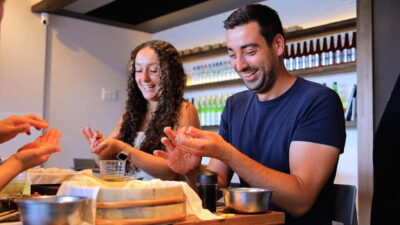 ★ 4.9Roll and Authentic Sushi Making Class in AsakusaFrom $581,957 reviews
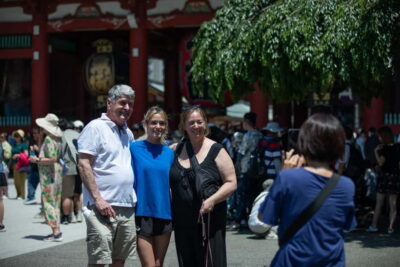 ★ 4.8Asakusa Walking Tour with Sensoji Temple VisitFrom $221,583 reviews
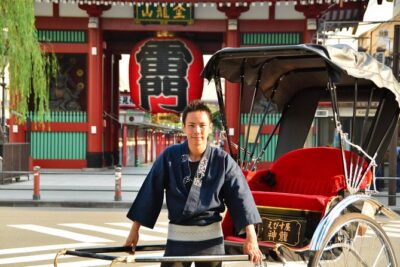 ★ 5.0Tokyo Asakusa Rickshaw TourFrom $421,375 reviews
 ★ 4.5Tokyo Panoramic 1 Day: Meiji Shrine, Asakusa, Odaiba and SKYTREE®From $851,222 reviews
 ★ 5.0Tokyo Go Kart: Asakusa, Skytree, and Akihabara **IDP MUST**From $99988 reviews
Filed on these lists too