
REVIEW · FULL-DAY
From Osaka or Kyoto: Full Day Sightseeing Tour of Kyoto
Kyoto in one long, well-planned day. This full-day sweep is made for first-timers coming from Osaka or Kyoto, with an air-conditioned vehicle and a guide-led route through Kinkaku-ji, Fushimi Inari, Nijo Castle, and Arashiyama. I like how the day is structured enough to cut through decision fatigue, so you can spend more time looking and less time figuring it out.
The tradeoff is time pressure, especially in the major photo stops like Kinkaku-ji and Bamboo Forest, so bring comfy shoes and expect a lot of walking. Also, the big sites have separate ticket prices, so your total cost is a bit higher than the headline fare.
In This Review
- Key Highlights You Will Care About
- A 9-Hour Kyoto Hits List From Osaka or Kyoto
- Kinkaku-ji Golden Pavilion: The Icon You See, Then Understand
- Fushimi Inari Taisha: Torii Gates That Change Your Pace
- Nijo Castle: Feudal Power, Palace-Style
- Arashiyama Bamboo Forest, Togetsukyo Bridge, and the Kimono Forest Circuit
- Bamboo Forest: worth the hype, but treat it like a walk
- Nonomiya Shrine: a different gate, calmer mood
- Togetsukyo Bridge: the icon and the river view
- Arashiyama Kimono Forest: a playful, photo-friendly installation
- The Guide Makes the Difference, Especially With Fast Stops
- Price and Value: $65.90 Plus the Kyoto Ticket Add-Ons
- How Much Walking? Plan Like It’s a Whole-Day Event
- Who Should Book This Kyoto Highlights Tour
- Should You Book This Tour?
- FAQ
- How long is the Kyoto full-day sightseeing tour?
- What is included in the price?
- Are Kinkaku-ji and Nijo Castle tickets included?
- Is lunch included?
- How big is the group?
- Can I get a refund if I cancel?
Key Highlights You Will Care About
- Air-conditioned ride, guided timing: you keep moving between far-flung Kyoto areas without burning your energy on transit.
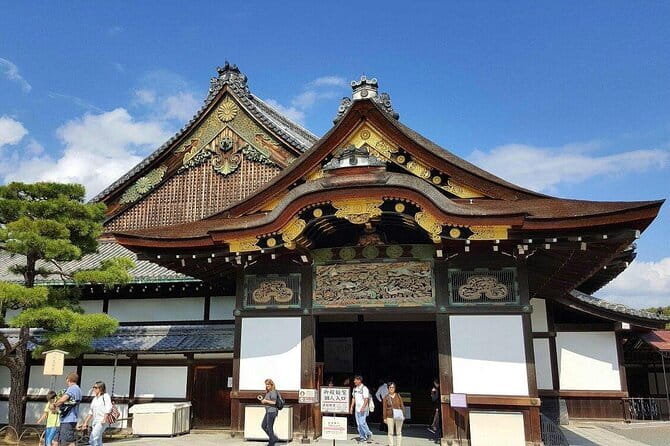
- Golden Pavilion plus castle architecture: Kinkaku-ji and Nijo-jo give you two very different Kyoto icons in one day.
- Fushimi Inari’s Senbon Torii walk: you get enough time to feel the gate corridor without rushing the whole shrine.
- Arashiyama stop sequence: Bamboo Forest, Nonomiya Shrine, Togetsukyo Bridge, and Kimono Forest are packed in for one smooth circuit.
- Small group feel (max 45): the group size is limited, and guides often manage it well, even when it is busy.
- Guides with culture stories: multiple guides named Theo, Amy, Anson, Lee, and Lucy received praise for making the day more than a checklist.
Still weighing up options in Osaka? These are the ones our reviewers rated highest.
- Osaka Go Karting Tour with Funny Costume
★ 5.0 · 2,658 reviews - Osaka Castle: Museum and Tower Entry Ticket
★ 4.5 · 2,380 reviews - Osaka: Shinsekai Food Tour with 13-15 Dishes at 5 Eateries
★ 4.8 · 2,204 reviews - Osaka Food Tour: 13 Dishes at 5 Local Eateries
★ 5.0 · 2,149 reviews
A 9-Hour Kyoto Hits List From Osaka or Kyoto
This is a full-day tour, about 9 hours, built around the classic Kyoto power stops. You travel by an air-conditioned vehicle and follow a set route, so you are not stuck planning train transfers or juggling opening hours. There is a guide with you the whole time, which matters in Kyoto where getting from one “must-see” to the next can eat up your day fast.
You start at one location and end back at a nearby drop-off and pick-up setup (the tour notes say it is near public transportation). The schedule is designed to cover multiple neighborhoods in one go, which is great when you only have one day in Kyoto. The downside is simple: you are on the move, and you will do your share of walking, especially around Arashiyama.
One small but helpful detail: it uses a mobile ticket. That means fewer paper worries, and it generally makes meeting up smoother.
Kinkaku-ji Golden Pavilion: The Icon You See, Then Understand
Kinkaku-ji, the Golden Pavilion, is a Zen Buddhist temple and a UNESCO World Heritage site, famous for its brilliant golden exterior and carefully arranged gardens. On this tour, you get about 40 minutes at the site. That is enough time to see the main view angles and walk the immediate areas around the pavilion, but it is not a “slow, linger for hours” visit.
Tickets for Kinkaku-ji are not included, listed at 500 yen. So I recommend you plan for cash or card access to cover that before you reach the front area, to avoid any awkward scramble.
What makes this stop work well on a group tour is that the guide can help you notice what you would otherwise miss in a quick pass. For example, the pavilion is all about reflection and geometry, and even a short visit can feel more meaningful when you understand why the setting is arranged the way it is. If you are there early, you often get better light for photos, and the site feels less like a pinball machine of camera phones.
Practical tip: wear shoes you can walk in for a full day. Even a “short” stop can involve uneven ground and crowd flow around the best viewpoints.
Fushimi Inari Taisha: Torii Gates That Change Your Pace
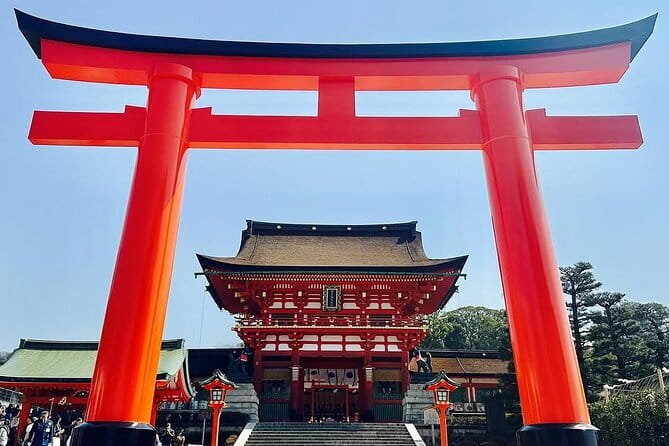
Next up is Fushimi Inari Taisha, the head shrine for Inari, the Shinto god associated with rice. The big draw is the Senbon Torii, thousands of vermilion torii gates that form a tunnel-like path. You have about 1 hour 10 minutes here, and admission is free.
This is the stop where a group tour can feel less rushed, because the gates create a natural flow. You do not just stand in one place. You walk, pause, look up, and keep going. The longer you spend, the more you notice that the shrine is not just one photo spot. It is a sequence of small visual moments, each gate framing the next bend of the path.
The value here is also cultural. Inari shrines are everywhere in Japan, but Fushimi Inari Taisha is the flagship. A guide can help you interpret what you are seeing, so it is not only red gates in a line. It becomes a place with purpose.
Practical tip: If you want fewer crowd vibes, aim to move steadily instead of stopping every few steps. And if you are photo-heavy, plan one main photo stop early, then let the gates lead you instead of fighting the crowd.
- Hungry Osaka Street Food Tour:15 Tastings & 3 Drinks with a Local★ 5.0 · 1,727 reviews
- Osaka: Tea Ceremony Experience★ 4.9 · 1,426 reviews
- Osaka Kickstart: Hotspots & Hidden Gems Tour★ 5.0 · 1,306 reviews
- Osaka: Hotspots & Hidden Gems Walking Tour Private or Group★ 4.9 · 1,300 reviews
- Deep Backstreet Osaka Tours (Option to add Dinner)★ 5.0 · 1,290 reviews
Nijo Castle: Feudal Power, Palace-Style
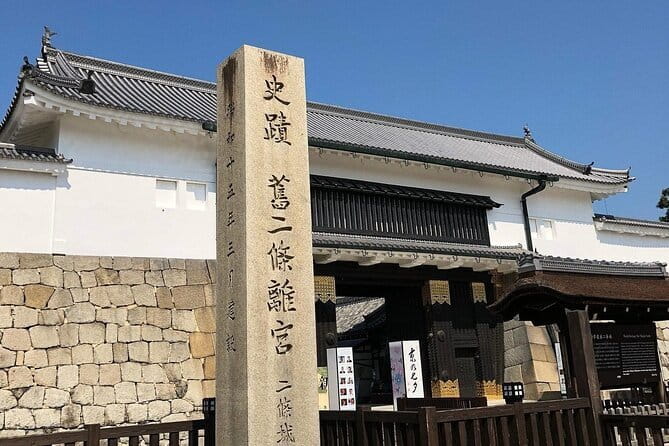
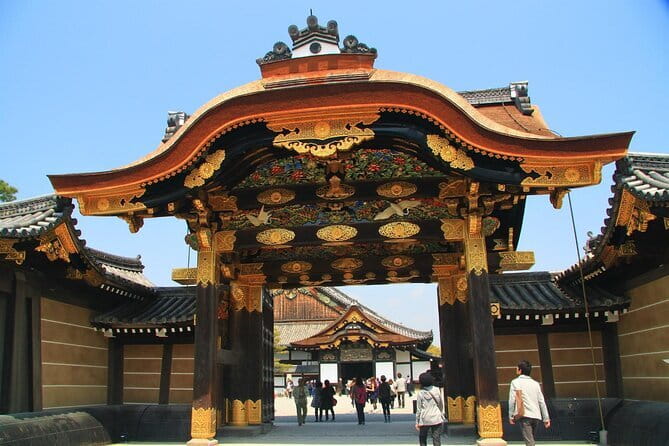
Nijo-jo, Nijo Castle, is the Kyoto residence of Tokugawa Ieyasu, built in 1603, and it is one of the best surviving examples of castle palace architecture from Japan’s feudal era. This stop gets about 1 hour, and the palace ticket is not included at 1,300 yen.
You do not just walk through halls like a typical museum. The architecture is part of the story, and Nijo Castle is famous for what you can read in its design. It is also a UNESCO World Heritage site (designated in 1994), so the site is preserved with the “big deal” recognition it deserves.
On a day like this, 1 hour can feel short, but it is usually enough to cover the highlights if the group stays aligned. The guide’s role matters here too: if you want to understand what you are looking at, having someone point out key features can turn a quick walk into real comprehension.
If you dislike crowded interior spaces, this might be the stop where you feel the group pressure most. Still, it is a strong counterbalance to Kinkaku-ji. One site is about calm, gardens, and shimmering surfaces. The other is about power, structure, and palace design.
Arashiyama Bamboo Forest, Togetsukyo Bridge, and the Kimono Forest Circuit
Arashiyama is Kyoto’s west-side nature and culture zone, and on this tour it is handled like a compact itinerary within the itinerary. You start with a general Arashiyama stop (about 20 minutes), then go into the Bamboo Forest (40 minutes), then Nonomiya Shrine (20 minutes), Togetsukyo Bridge (20 minutes), and the Arashiyama Kimono Forest (20 minutes). All of these stops are marked as admission free on the tour info.
Bamboo Forest: worth the hype, but treat it like a walk
The Arashiyama Bamboo Forest is a classic Kyoto symbol, known for tall bamboo stalks and a tranquil feel. Forty minutes is enough time to walk through the main areas and get photos from different angles. The key is to go with the flow and not get stuck at one vantage point, since the forest is an experience you move through.
Also, this is one of those stops where the tour pace can matter. If the day is hot, it is easy to feel tired quickly. One review specifically mentioned a hot day and praised the air-conditioned vehicle, which is a hint that the ride between stops can be your recovery time.
Nonomiya Shrine: a different gate, calmer mood
Nonomiya Shrine is in the Arashiyama district and stands out because it has a black torii gate instead of the more common vermilion gates. That small detail is exactly why this tour sequence works. It gives you variety, not just “look at famous thing, next.”
Togetsukyo Bridge: the icon and the river view
Togetsukyo Bridge is the most iconic landmark in Arashiyama. It was originally built during the Heian Period and reconstructed most recently in the 1930s, spanning the Katsura River area. The 20-minute stop is short, but it usually gives you enough time to get the main bridge photo and take in the river perspective.
Arashiyama Kimono Forest: a playful, photo-friendly installation
The Kimono Forest is an installation made of 600 clear acrylic cylinders about 2 meters tall, covered with colorful kimono fabric designs. It is not the same kind of historic site as a shrine or castle, but it is a fun visual break. If you like photography, this is an easy win because the materials are designed for a camera.
Overall, Arashiyama on this tour is about getting a taste of the area without needing to plan a half-day neighborhood route yourself. The downside is that you will not have time to deeply explore every side lane or temple pocket. You get the highlights, plus some texture, but you do not get the slow wander.
The Guide Makes the Difference, Especially With Fast Stops
Guides seem to be a core strength here, and it shows in the feedback tied to named guides like Theo, Theodore Chan, Amy, Anson, Lee, and Lucy. What comes through most clearly is not just facts, but pacing. People praised guides for staying engaging and for keeping the day on schedule without making it feel like everyone is being dragged.
If you get a good guide, you will get more than a list of places. You will get context, like why Kinkaku-ji and Nijo Castle represent different sides of Kyoto, and how to read a shrine environment like Fushimi Inari beyond the postcard gates. Several comments also mention the guide being accommodating and communicating in a way that helps the group find each other more easily.
That said, not every experience will feel identical. One review criticized the tour as rushed and said the guide experience did not feel strong for their group. This is the reality of any highlight tour: when there are many stops and a fixed route, you will feel the time limits. If you are sensitive to pacing, you should go into the day expecting motion, not a relaxed sightseeing day.
Price and Value: $65.90 Plus the Kyoto Ticket Add-Ons
The tour price is $65.90 per person, and the included items are an air-conditioned vehicle and a guide. Lunch is not included. Tickets for Kinkaku-ji (500 yen) and Nijo Castle (1,300 yen) are also not included.
Here is how I look at the value. You are paying for four things:
- Dedicated transport from Osaka or Kyoto through multiple neighborhoods
- A guide to organize the day and add meaning to what you see
- Entry-ticket flexibility for the most popular sites (you just pay the specific ones listed)
- Time savings from skipping DIY planning
If you add the listed tickets, your base “must pay” costs for these two stops come to 1,800 yen total, plus lunch. That is not cheap, but it is typical for the big Kyoto icons. The real question is whether you would rather spend your day figuring out transfers and building your own route, or letting someone handle the sequence.
Given the itinerary density and the fact that you also hit both classic Kyoto heritage (Kinkaku-ji, Nijo Castle) and iconic cultural sites (Fushimi Inari), I think the pricing makes sense for many first-time visitors. It is especially good if you want the main hits without losing a whole day to transit logistics.
How Much Walking? Plan Like It’s a Whole-Day Event
This is a full-day outing, and multiple comments pointed out that it is long and includes a lot of walking. The time at each stop is fairly compact, and Arashiyama is the biggest “movement zone” due to bamboo, shrine area, bridge, and the photo installation.
So I recommend you pack for walking, not museum shoes:
- Comfortable sneakers with good grip
- Water you can drink easily while moving
- Sunscreen or a hat, since Bamboo Forest and shrine paths can be exposed
Also, lunch is not included, and at least one comment noted that lunch time could be longer. In other words, do not assume you will have a leisurely sit-down meal. If you care about food time, consider bringing a light snack for the gap between major stops, then use lunch as your main meal when you get your break.
Who Should Book This Kyoto Highlights Tour
You should book this if:
- You want to see major Kyoto sites in a single day from Osaka or Kyoto
- You enjoy guided explanations and want the day to feel organized
- You are comfortable with a fast pace and do not need long, slow visits at every stop
You might skip this if:
- You hate crowds and need long quiet time at each attraction
- You want a relaxed itinerary with lots of free time
- You have limited mobility, since the day involves multiple walking sections and several stop-to-stop transfers
Group size is capped at 45 travelers, which helps, but it is still a group tour. If you like to roam independently, this might feel a bit structured.
Should You Book This Tour?
If your goal is a first-timer overview that covers Kinkaku-ji, Fushimi Inari, Nijo Castle, and Arashiyama in one manageable day, I think this is a strong choice. The combination of air-conditioned comfort, guide-led timing, and the density of iconic stops gives good value for visitors who do not want to plan transit and route building.
Book it if you are willing to accept the tradeoffs: the walking, the compressed stop times, and separate tickets for Kinkaku-ji and Nijo Castle. Skip it only if you want a slow, unhurried Kyoto day or you know you will struggle with time pressure.
FAQ
How long is the Kyoto full-day sightseeing tour?
The tour runs about 9 hours.
What is included in the price?
The tour includes an air-conditioned vehicle and a guide. It also uses a mobile ticket.
Are Kinkaku-ji and Nijo Castle tickets included?
No. Kinkaku-ji is an additional 500 yen, and Nijo Castle is an additional 1,300 yen.
Is lunch included?
No, lunch is not included.
How big is the group?
The tour has a maximum of 45 travelers.
Can I get a refund if I cancel?
Yes. You can cancel for a full refund up to 24 hours in advance of the experience start time.
Newest Osaka write-ups from the Loving Japan desk



Full-Day, side by side.
 ★ 4.5From Tokyo: Mount Fuji Full-Day Sightseeing TripFrom $684,970 reviews
 ★ 4.9Mount Fuji Full-Day Private Tour from Tokyo (Customizable)From $3931,470 reviews
 ★ 5.0Hiroshima / Miyajima Full-day Private Tour with Government Licensed GuideFrom $2021,298 reviews
 ★ 5.0Tokyo Private Full-Day Tour by Car or VanFrom $321684 reviews
 ★ 4.7From Tokyo: Must-Visit Mount Fuji Highlight Full-Day TourFrom $69532 reviews
 ★ 5.05 Top Highlights of Kyoto Full Day Bike Tour (E-bike option)From $172511 reviews
 ★ 5.0Full Day Biking Tour Exploring the Best of KyotoFrom $119498 reviews
 ★ 4.5Mt. Fuji, Hakone Full-Day Private Tour with English Driver GuideFrom $495458 reviews