
REVIEW · NAGOYA AND CENTRAL JAPAN
Sumo Tournament Experience in Nagoya
Sumo makes sense fast with the right guide. This July Grand Sumo Tournament in Nagoya is one of Japan’s few big yearly events in this city, and your English-speaking local sumo expert helps you read the rituals and matchups as they happen. I love how the explanations are practical, not just trivia, so you know what you are looking at from the first wrestler’s entrance.
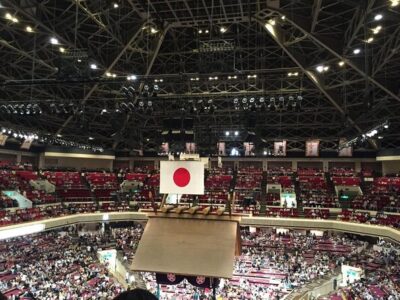
My other favorite part is the reserved chair seating and setup inside Aichi Prefectural Gymnasium. You get a strong view, plus tools like the banzuke-hyo rankings table, and an audio headset so you do not have to lean in all match. One thing to plan for: there can be a wait before you are seated, and the tour depends on a minimum group size, so it can be canceled if they cannot operate.
In This Review
- Key highlights you should care about
- Why Nagoya’s July basho feels special
- Price and value: what $228.62 buys you
- Timing and meeting at 2:00 pm: the match-day rhythm
- Aichi Prefectural Gymnasium: reserved seats and the culture behind the ring
- What you do there
- What you gain as a first-timer
- A realistic caution
- Banzuke-hyo and materials: your cheat sheet for following matches
- Seat tiers explained: picking B or C, A chair, and how to choose
- Chanko nabe dinner option: what you get and what to request
- Vegetarian option
- Drinks and outside food
- The guide factor: Kazou, Yoko, and why the explanations stick
- Who this tour suits best
- Practical tips to make your match day easier
- Should you book this Nagoya sumo tournament experience?
- FAQ
- When does the Nagoya sumo tournament take place?
- How long is the sumo tournament experience?
- What time do I need to meet?
- Are reserved seats included?
- Is hotel pickup included?
- Is dinner included?
- Can I request a vegetarian meal for chanko?
- Can I bring my own food or drinks into the arena?
- What if the tour does not meet the minimum group size?
Key highlights you should care about
- English sumo expert plus audio headset so you follow the rules, customs, and key wrestlers
- Reserved seats with chair seating (B or C-class, or A chair seating depending on your option)
- Rituals explained in plain terms including salt purification and what it signals
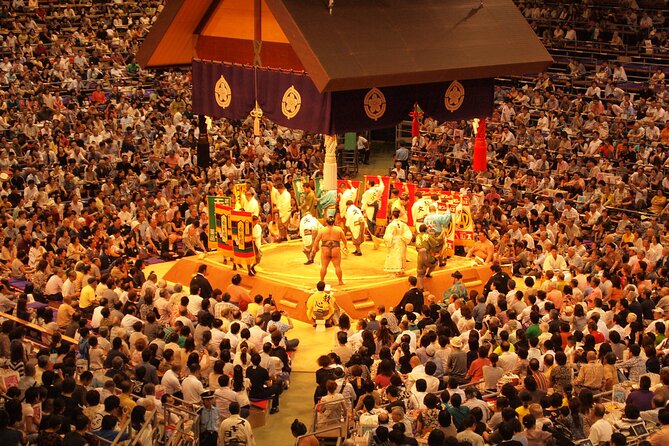
- Wrestler entrances before the match plus help cheering and meeting familiar names
- Optional chanko nabe dinner with a vegetarian option if requested on time
- Group size capped around 15 to 20 with a minimum of 15 to run the tour
Central Japan, beyond the obvious stop
- From Nagoya: Gujo, Hida Takayama, and Shirakawa-go Day Tour
★ 4.4 · 398 reviews - Ghibli Park 1-Day Bus Tour from Nagoya
★ 4.5 · 277 reviews - From Nagoya: Hida Takayama & Shirakawa-go Tour w/Opt. Lunch
★ 4.5 · 256 reviews - Hiking the Historic Nakasendo Trail [1 Day Tour from Nagoya]
★ 5.0 · 104 reviews
Why Nagoya’s July basho feels special
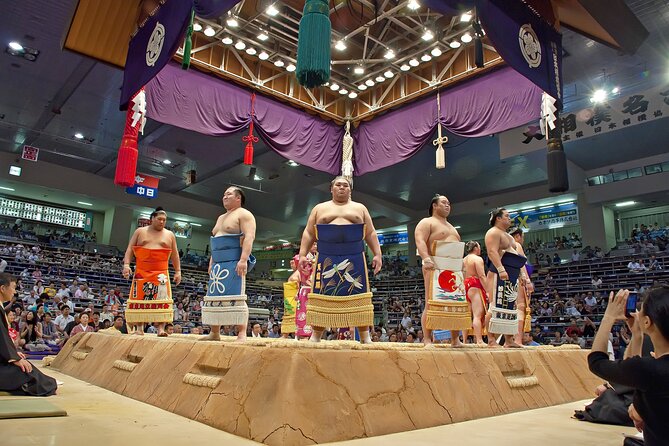
If you like sports, you will love sumo. But if you also like culture, you will enjoy it more once someone translates the meaning behind the pageantry. In Nagoya, the Grand Sumo Tournament runs only once a year in July, so this is not something you can casually repeat. The tour is built for that reality: it gives you the context you normally miss when you just show up and try to guess what everyone is doing.
The experience also works for different levels of interest. If you already follow wrestlers, you get help tracking the lineup and rankings. If you are brand-new, you get a guided way to understand the structure and the big moments that matter. The best part is that the explanations are timed to what you see, rather than coming in a lecture that has no connection to the arena.
Price and value: what $228.62 buys you
At $228.62 per person, this is not a casual add-on. You are paying for a few specific things that add up fast if you DIY them.
First, you get reserved tournament seats. In sumo, view matters. The tour places you in B or C-class reserved seats for the main tournament experience, described as having the best view of the match, with chair seating in the stadium. Depending on your seat selection, you may also end up with A-class reserved seats or A chair seats on the second floor for the premium join-in option.
Second, you get an English-speaking local sumo expert plus an audio headset. That is a big deal in Japan because the rules, rank structure, and rituals can be hard to decode without help. The headset means you can stay focused on the ring, instead of constantly hunting for where the guide is pointing.
Third, you receive sumo materials like a pamphlet and the banzuke-hyo (the rankings table). That turns the tournament from a blur into something you can follow. You also get a service fee included for getting the ticket, which saves time and coordination.
Optional, you can add the chanko nabe dinner experience. If you pick it, the chanko is served without drinks as the default meal, and a vegetarian option is available if you request it at least one week in advance.
One more practical note: the tour is often booked about 35 days in advance on average, so you generally want to plan sooner rather than later if you care about a specific seat tier.
Timing and meeting at 2:00 pm: the match-day rhythm
The meeting start time is 2:00 pm. Plan to arrive at least 10 minutes early. This tour is paced as a group, and if you are late, the tour can proceed without you, with no refund.
Also, think of the day as “events in sequence.” Before you get into your final seating spot, you may face a wait. That is not a flaw in the tour plan; it is how tournament logistics work. The tour notes that they must wait for all sumo matches to end before entering, and there may be congestion at the sumo museum area where you might be asked to visit on your own if the group walk becomes too difficult.
In other words, do not assume you will be sitting down instantly at 2:00 pm. If you bring that mindset, the wait is easier to handle.
Morning practice or an evening show. Both reviewed
- Nagoya: Grand Sumo Tournament Tour★ 4.8 · 44 reviews
Aichi Prefectural Gymnasium: reserved seats and the culture behind the ring
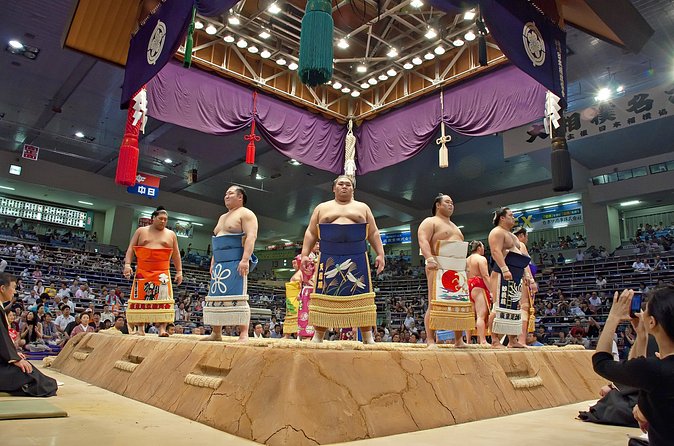
This is the heart of the experience, about 4 hours at the official tournament venue, with a group of up to 24 in the stadium during the event (and it requires a minimum of 15 to operate).
What you do there
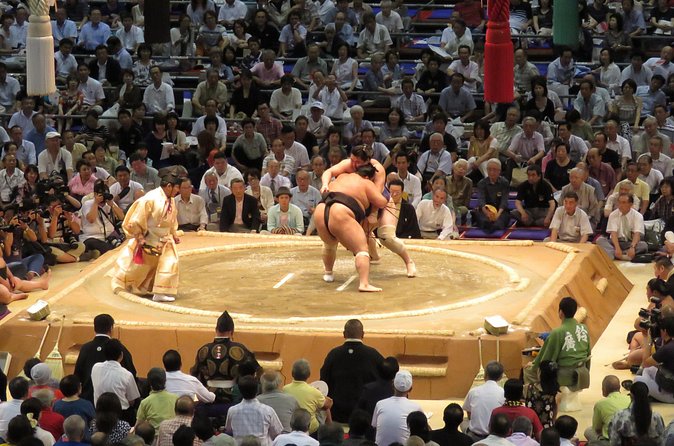
Once inside, you will be seated in reserved B or C-class chair seats, described as giving the best view of the match. You are not stuck watching from the edge with bad sight lines. The goal is simple: help you see the action clearly and follow the meaning behind it.
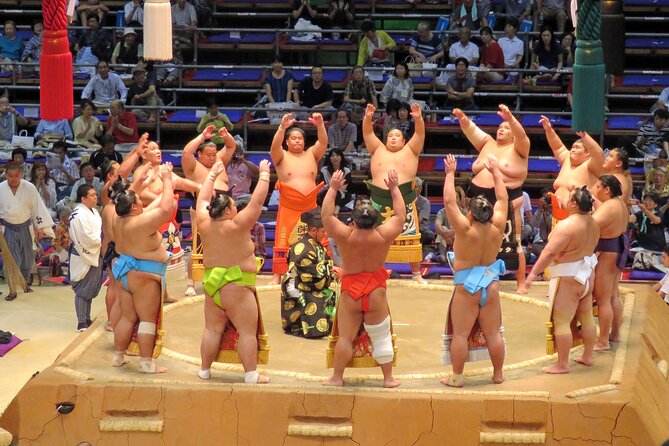
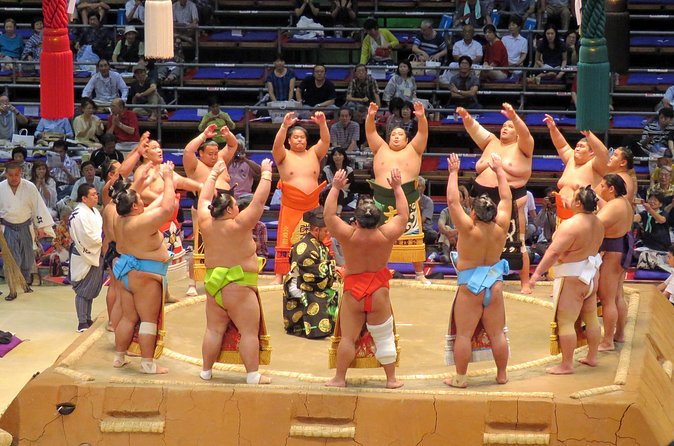
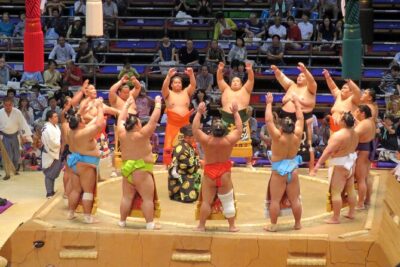
Before and during the tournament, your guide connects what you see to what it means. You learn about ancient traditions preserved in sumo, including the ritual use of salt purification, and what that does within the match atmosphere. You also cheer on and greet famous wrestlers as they enter the stadium for their big bouts.
What you gain as a first-timer
The tour is especially effective if you do not know sumo rules yet. You will still see a full sport event, but you also get the missing translation layer. You will understand how the structure of the day connects to ranks and matchups rather than treating each bout like a one-off.
A realistic caution
Because this is an active tournament day, there can be waiting and crowding. The tour specifically flags possible congestion at the sumo museum, and it also warns that you might need to navigate as a smaller sub-group if walking becomes too tight. If you hate crowded hallways, you can still do this, but keep your expectations flexible.
Banzuke-hyo and materials: your cheat sheet for following matches
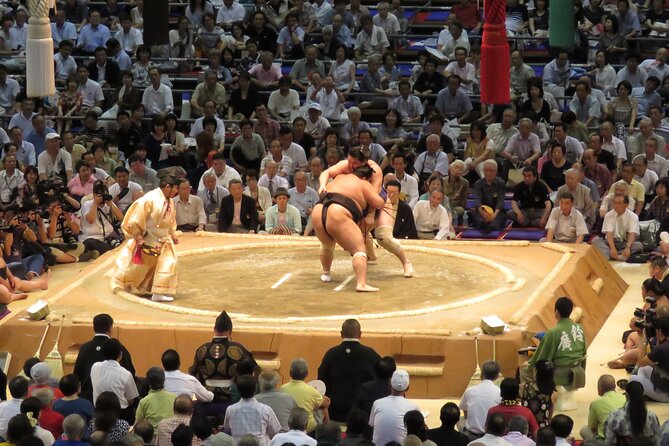
One included item you should not overlook is the banzuke-hyo, the rankings table. It is handed to you as part of the experience, along with a sumo pamphlet.
In plain terms, it helps you stop watching sumo as a series of random collisions. You begin to see how ranks and wrestlers connect, and why certain matchups feel like bigger deals than others. Even if you are not memorizing every name, having the ranking context in front of you makes the pace of the tournament easier to follow.
I also like that this is paired with on-the-spot explanation through the audio headset. You can look down at the banzuke-hyo and back up to the ring without losing the plot.
Seat tiers explained: picking B or C, A chair, and how to choose
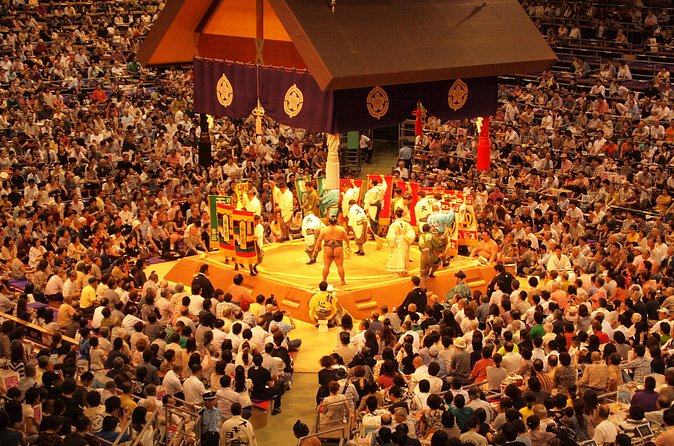
The tour includes either S-class reserved seats or A-class reserved seats depending on the option you choose at booking. For the standard setup, A-class reserved seats are part of the package.
There is also a join-in group option with premium seating details: for the Standard Tour with Premium Seat, the seats are described as second floor A chair seats, and the tour has a maximum of about 20 people in the same location with the English-speaking guide.
Here is how you can think about seat choice:
- If you want a strong view of the match action and you can get it, prioritize the option described with B or C-class reserved seats.
- If your priority is still clear viewing but your budget or availability pushes you to A-class seating, it can still be a good experience because the guide and headset do the heavy lifting.
If you are a serious sumo fan, I would take seat quality seriously. You are there for an up-close sports event, and sumo rewards watching carefully.
Chanko nabe dinner option: what you get and what to request
You can optionally add dinner at a local chanko hot pot restaurant. If you choose it at checkout, it is included as part of the tour experience.
Chanko nabe is often described as what sumo wrestlers eat in big quantities. The provided details say it uses chicken stock as the soup base and includes various vegetables. The tour also notes that chanko originated in the Ryokoku area, and it makes sense as a training-stable meal because it is easy to cook in large batches for many people at once.
Vegetarian option
A vegetarian option is available upon request if you make the choice at least one week in advance. The tour notes that traditional broth is typically made with pork or chicken, but the restaurant may substitute the broth for vegetarian diners. Once your dinner request is accepted, changes cannot be made one week before the tour date.
Drinks and outside food
For the dinner included, it is described as chanko hot pot without drinks as the default meal. Inside the arena, no outside food or drinks are allowed, though you can buy food from vendors within the arena.
So if you are hungry, plan on using the arena vendors for snacks if you need them during your wait.
The guide factor: Kazou, Yoko, and why the explanations stick
One theme in the guide feedback is how much passion and focus they bring. I think this is what turns a ticket purchase into an experience.
For example, Kazou is called out as a really great guide for sharing a lot of information about the tournament and its players, and for even sending pictures he took of the event. That kind of personal touch matters because you remember more than the match itself.
Yoko is praised for being extremely knowledgeable and passionate about sumo, with kids age 9 and 11 reportedly having a blast. That is a useful sign for families, because it suggests she can scale the explanations to different attention spans rather than assuming everyone already knows the basics.
If you care about authenticity, the “local sumo expert” angle is the point. The tour is not trying to turn sumo into generic entertainment. It treats traditions and match structure as something you can understand with the right guidance.
Who this tour suits best
This is a strong fit if you:
- Want to watch Japan’s top sumo event in Nagoya in July with English guidance
- Like sports but also want to understand rituals, not just outcomes
- Appreciate reserved seating so you are not scrambling for your view
- Want either a standard tournament visit or a fuller package with optional chanko nabe dinner
- Are traveling with kids, especially if they can handle a few hours in an exciting venue with clear explanations
It might be less ideal if:
- You get stressed by crowding and waiting before seating
- You do not like group pacing, since this is a join-in group experience
- You need total flexibility at the venue, since the tour timing follows tournament flow
Practical tips to make your match day easier
Here are a few things that will help you get the most out of the 4 to 5 hour experience.
- Bring a positive mindset about waiting. The tour explicitly warns you might wait prior to seating because matches must finish first.
- Use the headset and let your eyes do the work. With the audio, you do not have to follow the guide with your head turned all the time.
- If you buy snacks, plan to do it inside the arena. Outside food and drinks are not allowed, but vendors are available.
- If you choose chanko dinner and you want vegetarian, submit that request with enough time so it can be arranged at least one week before the tour date.
- If you have kids, this tour can be a good match, but still bring a little patience for the venue flow and group movement.
Should you book this Nagoya sumo tournament experience?
I would book this if you want a guided way to watch Nagoya’s July Grand Sumo Tournament and you care about understanding what you are seeing. The reserved chair seating, the banzuke-hyo ranking sheet, and the English expert with an audio headset are the big value drivers. You are also not just watching the sport, you are getting the rituals explained, including salt purification and the meaning of entrances.
I would hesitate if you are extremely sensitive to crowds or waiting, because tournament logistics can create delays before seating. I would also be realistic if you are traveling with tight scheduling around matchday, since the tour runs as a group and follows the arena flow.
If you are a sumo fan, a curious newcomer, or someone traveling with family who wants a real Japan sports moment, this is a strong bet for your July Nagoya plans.
FAQ
When does the Nagoya sumo tournament take place?
The official basho in Nagoya happens in July, once a year.
How long is the sumo tournament experience?
It runs about 4 to 5 hours (approx.), with the tournament portion described as a 4-hour experience at the venue.
What time do I need to meet?
The start time is 2:00 pm. Try to arrive at least 10 minutes early.
Are reserved seats included?
Yes. The tour includes admission ticket seating, either S-class reserved seats or A-class reserved seats, depending on the option you select. Some join-in options include chair seating on the second floor.
Is hotel pickup included?
No. Hotel pickup is not included.
Is dinner included?
Dinner at a local chanko hot pot restaurant is included only if you select the dinner option at checkout.
Can I request a vegetarian meal for chanko?
Yes, a vegetarian option is available upon request, but you need to request it at least one week in advance.
Can I bring my own food or drinks into the arena?
No. Outside food and drinks are not allowed in the arena, but food is available for purchase from vendors inside.
What if the tour does not meet the minimum group size?
The tour requires a minimum number of travelers to operate. If it is canceled because the minimum is not met, you will be offered a different date or a full refund.
Practice Rooms and Show Nights
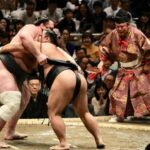
Central Japan Beyond the Obvious


Newest Nagoya write-ups from the Loving Japan desk
Nagoya and Central Japan, side by side.
 ★ 5.0Ultimate Sumo Tournament: Tokyo, Osaka, Nagoya, FukuokaFrom $184468 reviews
 ★ 4.4From Nagoya: Gujo, Hida Takayama, and Shirakawa-go Day TourFrom $61398 reviews
 ★ 4.5Ghibli Park 1-Day Bus Tour from NagoyaFrom $179277 reviews
 ★ 4.5From Nagoya: Hida Takayama & Shirakawa-go Tour w/Opt. LunchFrom $61256 reviews
 ★ 5.0Hiking the Historic Nakasendo Trail [1 Day Tour from Nagoya]From $210104 reviews
 ★ 5.0Nagoya Highlight Tour guided by a friendly localFrom $11286 reviews
 ★ 4.9Japanese Traditional Sweets making and Tea CeremonyFrom $1876 reviews
 ★ 4.6Magome-juku, Tsumago-juku & Ena-kyo 1d Bus Tour from NagoyaFrom $6175 reviews
Filed on these lists too