
REVIEW · AKIHABARA, ANIME AND OTAKU CULTURE
Tokyo Manga Drawing Experience Pro Artist Workshop & MangaHistory
Manga, but make it yours. This Tokyo workshop blends manga history with hands-on coaching so you leave with a finished piece you can actually show off. I love the friendly, courteous vibe, and I love that the instructor walks you step by step while also explaining what makes manga work on the page. One thing to consider: it is a single 3-hour session, so it is best to aim for a strong finished souvenir rather than a super-detailed lifelong project.
The class is built for beginners, with all tools provided and a small group cap (max 6), so you are not stuck just watching from the back. You can pick a morning, afternoon, or evening slot, and the meeting point is fixed near Shibuya at Lawson in Hiroo. Plan for a relaxed pace, because you are doing sketching, inking, and shading in one go.
In This Review
- Key Highlights You Will Care About
- Where the Workshop Starts in Hiroo, Shibuya
- How the 3 Hours Unfold, From Manga History to Your Final Page
- Manga History That Actually Helps Your Drawing
- Step-by-Step Drawing: Composition, Expressions, Poses, and Inking
- What You Can Draw When You Have No Experience
- Tools, Drinks, and the Small-Group Advantage (Max 6)
- Price and Value: Is $100 for 3 Hours Fair?
- Getting Ready: What to Bring (and What You Can Skip)
- Who This Workshop Is Best For
- Should You Book This Manga Drawing Workshop?
- FAQ
- How long is the Tokyo Manga Drawing Experience workshop?
- How many people are in the workshop?
- Do I need any drawing experience before I go?
- Are the drawing tools included?
- Can I draw a character I already like?
- Where do I meet for the workshop?
- Is private transportation included?
- What is the cancellation policy?
Key Highlights You Will Care About
- Small group, max 6 means more personal feedback and faster help when you get stuck.
- Manga history primer gives context for the drawing choices you are making.
- Step-by-step workflow covers sketching, inking, and adding shading and depth.
- Pick any character or create your own story, so you can tailor it to your favorites.
- Tools, drinks, and snacks included so you can focus on drawing, not logistics.
- Take-home finished artwork makes this feel like a real souvenir, not just a photo stop.
Deeper into Akihabara, if that is your afternoon
- Official Street Go-Kart Tour – Akihabara
★ 5.0 · 1,578 reviews - Tokyo Go Kart: Asakusa, Skytree, and Akihabara **IDP MUST**
★ 5.0 · 988 reviews - Akihabara Anime & Game Adventure Walking Tour (Group or Private)
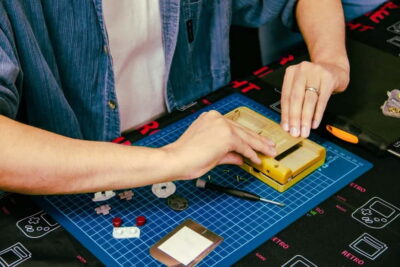
★ 5.0 · 404 reviews - Tokyo: Gameboy Mod Workshop at Akihabara
★ 5.0 · 253 reviews
Where the Workshop Starts in Hiroo, Shibuya
You meet at Lawson, 1-chōme-16-3 Hiroo, Shibuya, Tokyo (150-0012). This matters more than it sounds, because Tokyo meeting points can be surprisingly specific, and you want to be at the right spot on time. The good news is it is near public transportation, so you should be able to get there without a complicated transfer plan.
The class ends back at the meeting point, so you are not dealing with a confusing drop-off. Also, you get a mobile ticket, which keeps you from rummaging for paper when you are already navigating trains and streets.
If you are the type who likes to show up early, I recommend doing that here. A short buffer helps you settle in, grab a drink or snack after you arrive, and start drawing without that rushed feeling.
How the 3 Hours Unfold, From Manga History to Your Final Page
The workshop runs about 3 hours. The format is relaxed but structured, and that balance is what makes it work for beginners.
First, you get an overview of manga history and famous artists and works. This is not just trivia. It helps you understand why certain panel layouts, expressions, and pose choices feel natural in manga, and why some styles look the way they do.
Then you start creating. You choose a character or concept, and you work with the pro artist to shape your idea into something you can draw clearly. The instructor focuses on practical basics like:
- composition (where things sit on the page)
- expressions (how to show emotion with line and shape)
- poses (how to make the body look active and readable)
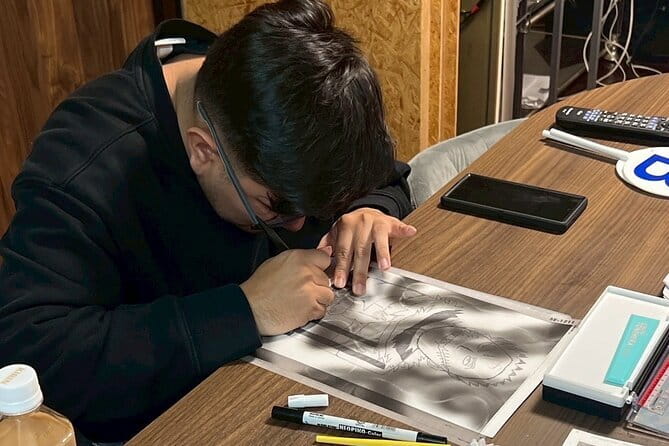
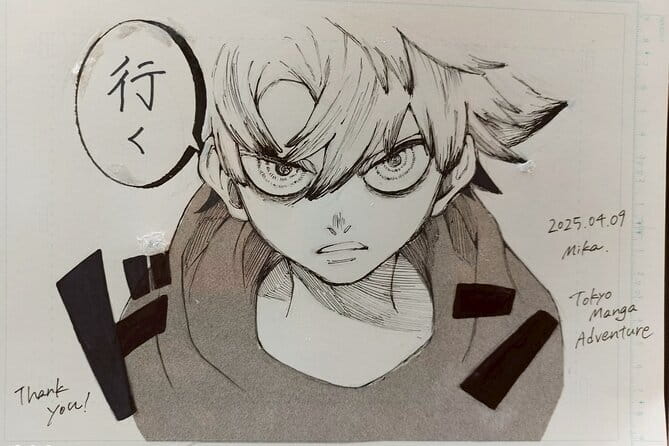
Finally, you go through the traditional creation steps, from pencil sketching to inking, then shading and depth. By the end, you take your finished artwork home.
One small consideration: because everything happens inside one session, you should keep your goals realistic. The “win” here is finishing a clean, satisfying manga piece you can carry home, not producing a multi-page masterpiece.
Manga History That Actually Helps Your Drawing
I appreciate when a history segment does more than fill time. Here, the manga history piece gives you a framework for your own art choices.
You learn about the evolution of manga, plus famous artists and works, and the instructor uses that background to connect style to technique. You start to see that what looks like a simple line drawing has rules behind it. Those rules affect how characters feel alive.
A friendly, important detail from the experience feedback is the staff tone. People specifically praise the team for being courteous and friendly, and that matters because history can feel like a lecture. In this setting, it is more like guidance. You are learning why certain visual patterns work, and then you apply that right away.
This is the part of the class that benefits you most if you are a fan who never really studied manga techniques. You do not need prior art skills. You just need attention and a willingness to try the steps once you get them.
Make something to take home. Other workshops
- Tokyo Shinjuku Chopsticks Making Class★ 5.0 · 1,763 reviews
- Chopstick Making Workshop in Ginza★ 4.8 · 1,366 reviews
- Tokyo Sumo Experience: Chanko & Mochi with a Former Pro★ 4.8 · 567 reviews
- Kintsugi Experience: Art of Golden Joinery in Tokyo★ 5.0 · 467 reviews
- Tokyo Chopstick Making Workshop with Artisan★ 5.0 · 466 reviews
Step-by-Step Drawing: Composition, Expressions, Poses, and Inking
The “pro artist” part is not hype. You get real coaching while you draw. The teaching style is step-by-step, and that is exactly what you want in a beginner class.
Here is the flow you should expect:
- Pencil sketching
You map your character and main elements first. This is where composition comes in. The goal is clarity, so your page reads instantly.
- Guided inking
Inking is where your lines become the manga lines. The instructor stays close to help you correct issues early, like uneven line weight or shapes that are getting lost.
- Shading and depth
Then you add tone. Shading is what turns a flat sketch into something with volume and mood.
You also build your character with focus on expression and pose. Expressions are not just about eyes and mouths. They are about how the face signals emotion. Poses are about readability, not realistic anatomy. Manga exaggerates, but it does it with structure, and the instructor helps you land that structure.
If you tend to overthink art, you will probably like the pacing. You are not being asked to “figure it out alone.” You are being taught a sequence, then you practice it immediately.
What You Can Draw When You Have No Experience
One of the best parts for first-timers is that you can participate with no experience necessary. All drawing instructions and tools are provided, so you are not trying to hunt down pens, paper, or special supplies in advance.
You also get creative freedom. You can:
- draw a character you like, or
- create something original
This flexibility is practical. If you already have a favorite character, you can lean into that and focus on learning technique. If you want to be original, you can build a concept around your style without needing to copy a specific reference.
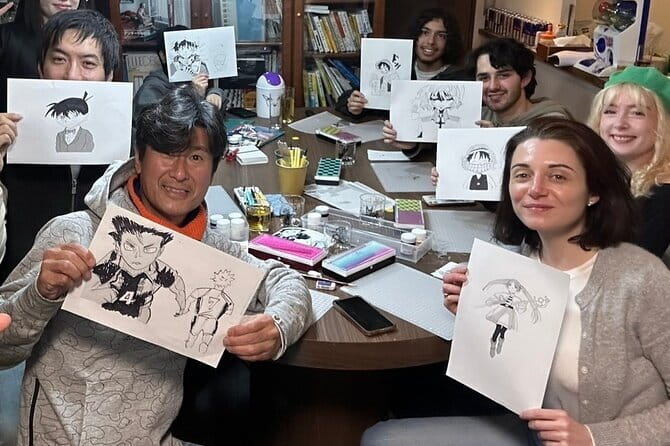
The group setting supports this. Because the maximum is 6 travelers, you are more likely to get feedback that fits your specific choice, whether it is a familiar character or an original design.
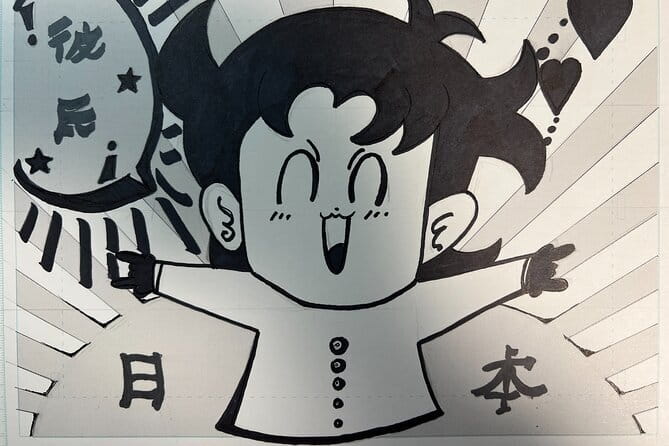
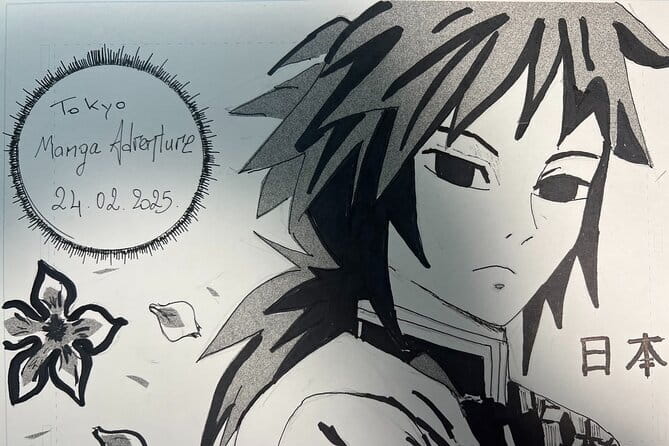
And because you work from sketch to finished inking and shading during the session, you will leave with a completed piece, not just an unfinished plan.
Tools, Drinks, and the Small-Group Advantage (Max 6)
This is one of those experiences where the details matter. You get the tools needed for drawing manga, plus drinks and snacks. That means you can arrive and start without scrambling for supplies. You are also not forced to ignore your comfort needs while drawing.
The small-group size is the real value multiplier. With a max of 6, the instructor can correct your line work and composition while you are still in the early stages. That is how you avoid the common beginner problem: working for 90 minutes on something that later turns out to be hard to fix.
The feedback from past participants leans strongly into this point. People describe the team as friendly and highlight the staff giving an overview of manga and its history, then showing how to use the tools to draw a character step by step.
So yes, it is a workshop. But it also functions like a private lesson inside a small room.
Price and Value: Is $100 for 3 Hours Fair?
At $100 per person, you are paying for three things at once:
- a pro artist instructor (real teaching, not just a demo)
- the included tools plus snacks and drinks
- a take-home finished artwork you complete during the class
For Tokyo, that can be fair value if you want more than a photo or a generic activity. Art classes can get expensive, especially when tools are not included or when the instructor time is limited. Here, the tools are provided, and the group stays small, which means your instructor time is used well.
Also, the scheduling choice matters. You can pick a morning, afternoon, or evening class. If you are trying to build a tight itinerary around trains, dinner plans, or other activities, that flexibility can save you time and reduce stress.
If you are comparing options, I would ask yourself this: do you want a souvenir that took effort and skill, or do you just want a quick activity? If you want the first one, this price is easier to justify.
Getting Ready: What to Bring (and What You Can Skip)
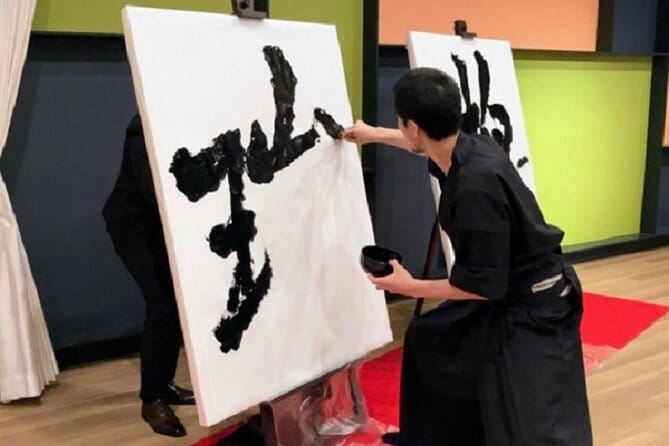
The class is designed for you to show up with almost nothing. You do not need experience, and all tools and materials are provided.
So what should you bring?
- a curious mindset
- patience for learning new tools
- whatever you need for basic comfort (like water habits or taking notes)
What you can skip:
- bringing drawing supplies
- preparing a sketch in advance
Because the workshop includes snacks and drinks, you can treat it like a self-contained creative block. That is great if your day already has a long list of stops.
Who This Workshop Is Best For
This works well if you:
- love manga and want to understand how it is made
- are curious about the culture, including manga history and famous works
- want a hands-on activity that ends with something you keep
- prefer small-group instruction over big tours
It also suits you if you are traveling solo or with a friend. The instructor can still guide you, and you still get the small-group attention.
If you are an advanced artist, you might still enjoy it, but I would treat it as a guided introduction to manga-style steps rather than advanced specialization. The goal is a completed souvenir piece within a single session.
Should You Book This Manga Drawing Workshop?
I would book it if you want a Tokyo activity that feels personal and practical. You get step-by-step guidance, a friendly instructor approach, and the best kind of souvenir: one you made yourself.
Book it sooner if you can. The average booking lead time is about 28 days, so popular times can go fast. Also, choose the class slot that matches your energy level. Morning and evening can feel very different in Tokyo, especially after a day of walking and trains.
On the flip side, I would skip it if you are looking for a long, multi-session art training program. This is a single workshop. You will learn key steps and leave with a finished page, but it is not designed to turn you into a manga professional.
FAQ
How long is the Tokyo Manga Drawing Experience workshop?
It lasts about 3 hours.
How many people are in the workshop?
The maximum group size is 6 travelers.
Do I need any drawing experience before I go?
No experience is necessary. Tools and instructions are provided.
Are the drawing tools included?
Yes. The tools and materials needed for drawing manga are included.
Can I draw a character I already like?
Yes, you can choose any character, or create your own original work.
Where do I meet for the workshop?
You start at Lawson, 1-chōme-16-3 Hiroo, Shibuya, Tokyo 150-0012, Japan, and the activity ends back at the same meeting point.
Is private transportation included?
No, private transportation is not included.
What is the cancellation policy?
You can cancel for free up to 24 hours in advance for a full refund.
Made by Hand, and Yours to Keep

Akihabara After the First Stop


Newest Tokyo write-ups from the Loving Japan desk



Akihabara, Anime and Otaku Culture, side by side.
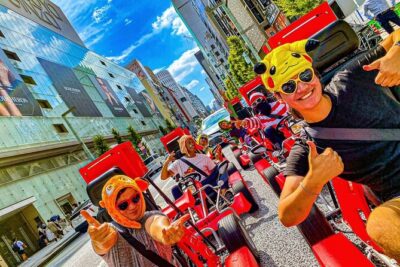 ★ 5.0Official Street Go-Kart Tour – AkihabaraFrom $611,578 reviews
 ★ 5.0Tokyo Go Kart: Asakusa, Skytree, and Akihabara **IDP MUST**From $99988 reviews
 ★ 5.0Akihabara Anime & Game Adventure Walking Tour (Group or Private)From $90404 reviews
 ★ 5.0Gameboy Mod Workshop at AkihabaraFrom $360253 reviews
 ★ 4.8Owl Cafe Tokyo Akiba FukurouFrom $35154 reviews
 ★ 5.0Akihabara Tailor-made Private Tour for Anime FansFrom $132142 reviews
 ★ 5.0Tokyo Cute Bento Cooking Class – Make a Kawaii Character LunchboxFrom $66126 reviews
 ★ 5.0Original Street Kart Experience from AkihabaraFrom $51111 reviews
Filed on these lists too