
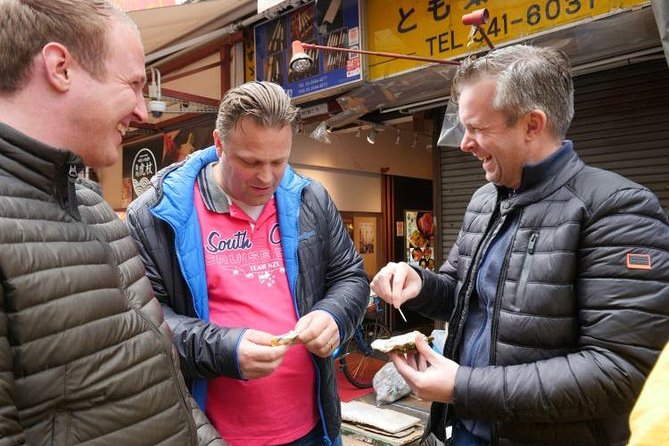
REVIEW · TSUKIJI AND TOYOSU FISH MARKETS
Tsukiji Fish Market Small-Group Food Walking Tour
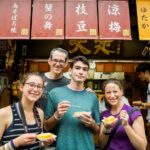
Your nose leads before your eyes do. In Tsukiji Outer Market, you get hit with the smell of grilled seafood and soy, then you learn how food, worship, and tradition sit side by side. I love that the tour builds in a seafood lunch, and it also takes you to a Buddhist temple and Shinto shrine as part of the route.
I also like the way the morning keeps you moving through the market by stages, not just wandering. You’ll spend time in the Old Tsukiji Market and the Tsukiji Jogai Market, with multiple sampling stops that make the crowds feel manageable instead of chaotic.
One heads-up for your expectations: the inner wholesale fish market moved to Toyosu, so you are mostly experiencing the Outer Market food scene. Also, vegan options are not available, and the operator can’t guarantee allergy-free or diet-restricted meals.
In This Review
- Key highlights to know before you go
- Tsukiji Outer Market after the big move to Toyosu
- Price and time: how $87.37 makes sense for 3 hours
- Start point at Tsukiji Station: get oriented fast
- The tasting loop: how you actually eat your way through Tsukiji
- Lunch at the market: what included means in real life
- Stop at the Old Tsukiji Market: history, religions, and a view
- Tsukiji Jogai Market for the final round of seafood snacks
- Shrines, temple steps, and why it pairs so well with food
- What to expect from the guide (and why guide quality matters)
- Allergy, vegan, and substitution reality (read this before you plan)
- Who this tour suits best, and who should skip it
- Should you book Tsukiji Fish Market Small-Group Food Walking Tour?
- FAQ
- Where is the meeting point for the tour?
- How long does the Tsukiji Fish Market small-group tour take?
- Is lunch included in the tour?
- Are vegan options available?
- Can the tour accommodate allergies or dietary restrictions?
- Can I cancel for a full refund?
Key highlights to know before you go
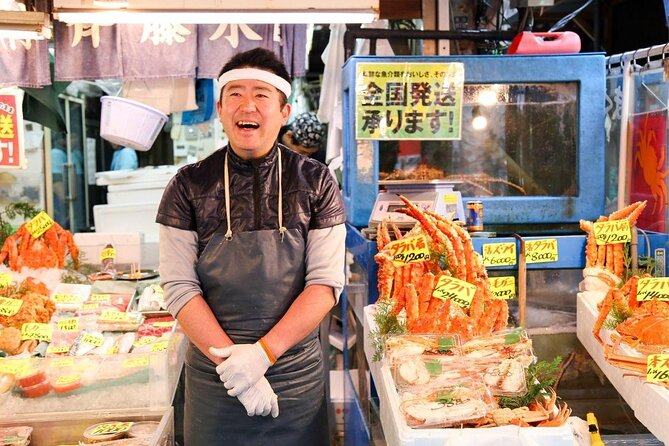
- Seafood lunch included as a main part of the experience, not an afterthought
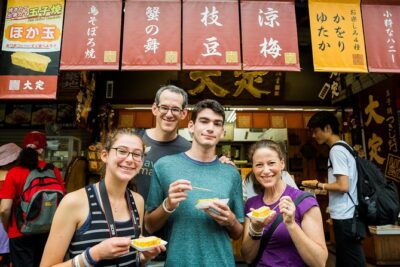
- Food sampling at several stalls across the Outer Market area
- Temple and shrine visits to connect the food with Japanese belief and place
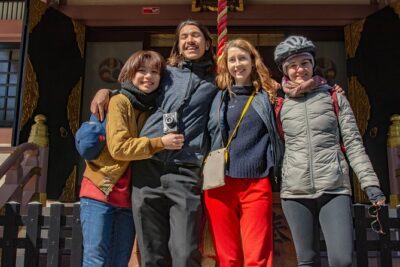
- Small group, up to 7 people, so it stays conversational and not gridlocked
- Strong “come hungry” energy, with more than a couple of tiny bites
- Heat reality check, since summer in Japan is hot and humid, bring water and a hat
Hungry earlier than that? Other market breakfasts we tried
- Tokyo Tsukiji Fish Market Food and Culture Walking Tour
★ 5.0 · 3,184 reviews - Tokyo: Tsukiji Fish Market Food and Walking tour
★ 5.0 · 1,724 reviews - Tokyo: Tsukiji Fish Market Guided Walking Tour
★ 4.9 · 1,397 reviews - Tokyo Sushi Making Class in Tsukiji with Professional Chef
★ 5.0 · 1,177 reviews
Tsukiji Outer Market after the big move to Toyosu
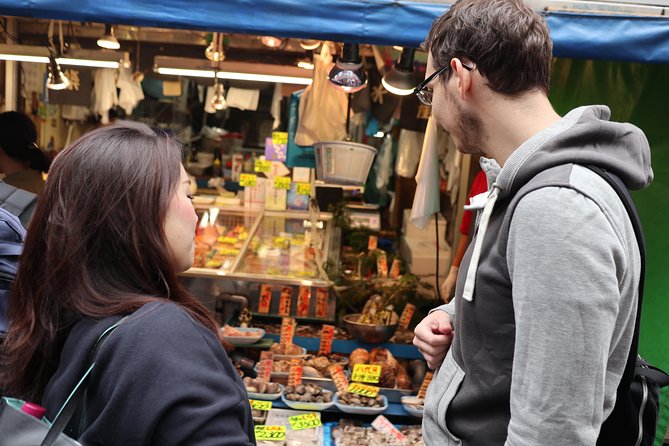
If you have been picturing the old-school inner auction vibe, update your mental map. The main inner wholesale market moved to Toyosu, so you will not be standing inside that wholesale machinery.
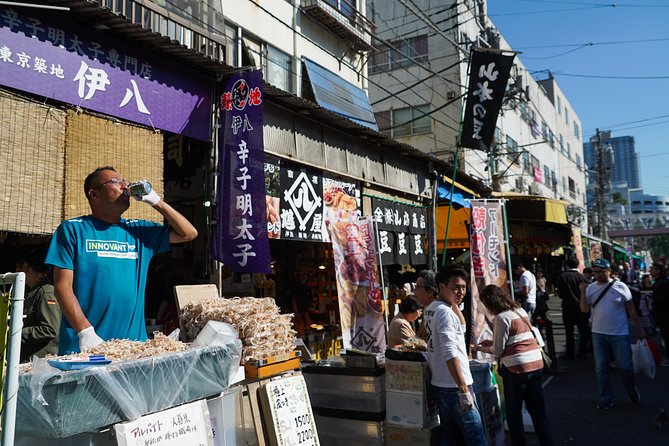
What you get instead, and what makes this tour worth your time, is the Outer Market culture. This is where seafood shops and food specialties show up for daily customers, plus the crowd of people who come to snack your way through Tokyo. In practice, that means more strolling time, more street-level tasting, and more variety across stalls.
The tour also adds something a lot of quick food walks skip. You will pair eating with spiritual landmarks. That mix matters, because Tsukiji is not just a place where fish gets sold. It is also a place where people come for ritual, community, and continuity.
Price and time: how $87.37 makes sense for 3 hours
At $87.37 per person for about 3 hours, you are paying for three things at once: a guided route, multiple tastings, and a seated lunch. In Tokyo, where good food can be pricey and market neighborhoods are dense, having a guide who can steer you to the right stalls is where the value shows up.
The other value lever is group size. This runs with a maximum of 7 travelers, which helps you avoid the “single-file herd” feeling. You get more room to ask quick questions and to move with the flow instead of getting stuck behind someone who ordered at the wrong moment.
One practical note: this tour is typically booked about 40 days in advance on average. If you want a specific day, it is smart to plan ahead and not treat it like a last-minute snack plan.
Start point at Tsukiji Station: get oriented fast
The meeting point is Tsukiji Station, Exit 1. The guide will be waiting there, and you will start with that first short walk segment near Tsukiji Eki mae.
Why it matters: Tsukiji Station is busy, and the market lanes are not laid out like a shopping mall. When you arrive, give yourself a little buffer so you can confirm you are at the right spot and start walking on time. Wear shoes you can stand in for a while. The area is tight, and you will keep turning corners.
Also, this is one of those Tokyo mornings where weather can hit hard. Summer is hot and humid, so bring water and a hat. The tour runs fast enough that heat can feel like it is sneaking up on you.
- Mt Fuji and Hakone 1-Day Bus Tour Return by Bullet Train★ 5.0 · 26,383 reviews
- 1-Day Tokyo Bus Tour★ 5.0 · 14,250 reviews
- Tokyo: teamLab Planets TOKYO Digital Art Museum Entry Ticket★ 4.6 · 9,779 reviews
- Mt Fuji & Hakone Cruise, Drum Show Bullet Train 1 Day from Tokyo★ 4.0 · 7,413 reviews
- Tokyo: Shinjuku Food Tour (13 Dishes at 4 Local Eateries)★ 5.0 · 6,603 reviews
The tasting loop: how you actually eat your way through Tsukiji
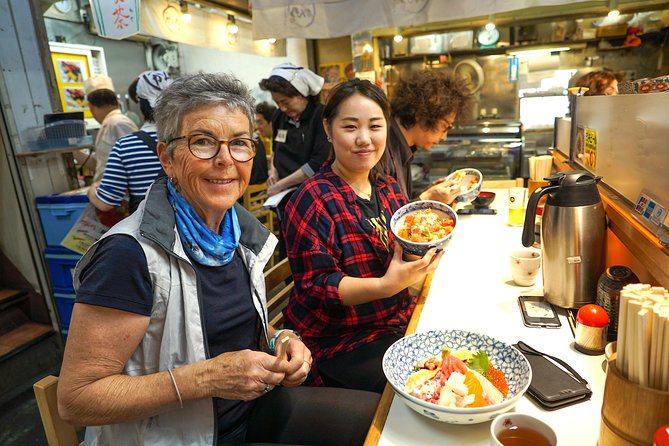
This is not just one stop and then you’re done. You will sample around the market area, then you will hit two major market zones for more eating and variety.
Think of it as a loop with different “flavors of Tsukiji”:
- an initial market stroll and tastings
- a transition to the Old Tsukiji Market for more samples and context
- another sampling section at the Tsukiji Jogai Market for the last round
One thing I like about this structure is that it keeps you from guessing what to order. In a market like this, choosing food is half the battle. A guide helps you avoid the time sink of comparing menus while everyone else is already eating.
Lunch at the market: what included means in real life
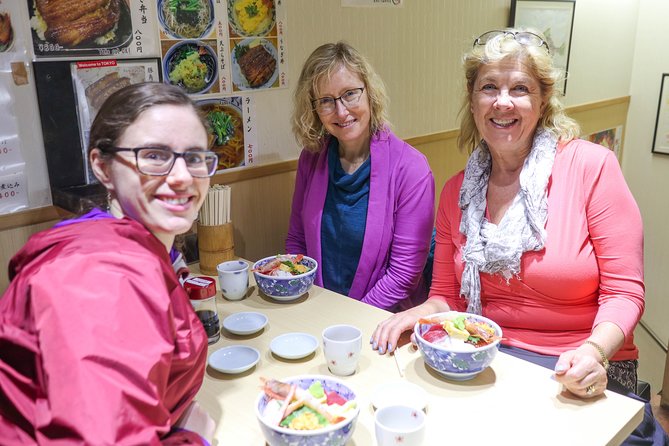
The tour includes a fresh seafood lunch. In a good market lunch, you want two things: first, something that feels like Tsukiji instead of generic “Japanese food,” and second, a meal that actually sits right after tastings.
Many people do end up ordering (or selecting) their lunch item as part of the experience rather than being served one fixed dish. The point is you are not stuck with a sad placeholder just because you joined a tour.
What does the lunch tend to feel like? It is typically a sit-down meal in a small spot where the food comes from the market ecosystem right outside. If you are a seafood fan, this is usually the moment you notice the difference between “I tried fish” and “I tried fish that tasted like it came from nearby this morning.”
Also, come hungry. Even if the plan is described as snacks plus lunch, the sampling rhythm often delivers more than the expected tiny bites.
Stop at the Old Tsukiji Market: history, religions, and a view
After lunch and initial sampling, you move into the Old Tsukiji Market area for about 20 minutes. Admission there is free, so you are paying for the guidance and the tasting stops, not entry fees.
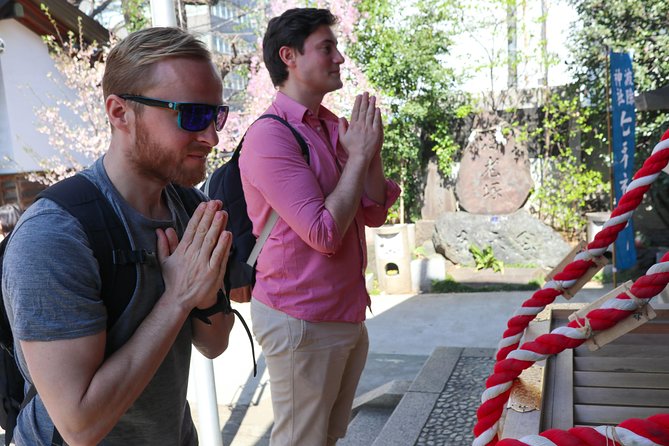
What makes this stop special is the cultural layer. You will learn about the building’s history and religions in Japan. The tour also includes visits connected to both Buddhist and Shinto traditions.
Then there is the payoff moment: you get to see a beautiful Tokyo city view. Some tours in this area also include a lookout over Tokyo bay, which adds a nice contrast to the tight market streets. It helps you reset your brain between eating rounds.
A practical drawback: market lanes are tight and there are many signs asking you not to stop and eat in certain spots. Your guide will help you time bites and move so you are not blocking foot traffic.
Tsukiji Jogai Market for the final round of seafood snacks
Next is Tsukiji Jogai Market, again around 20 minutes, with more food sampling. The idea here is straightforward: keep your taste buds moving and let you hit more specialties before you exit.
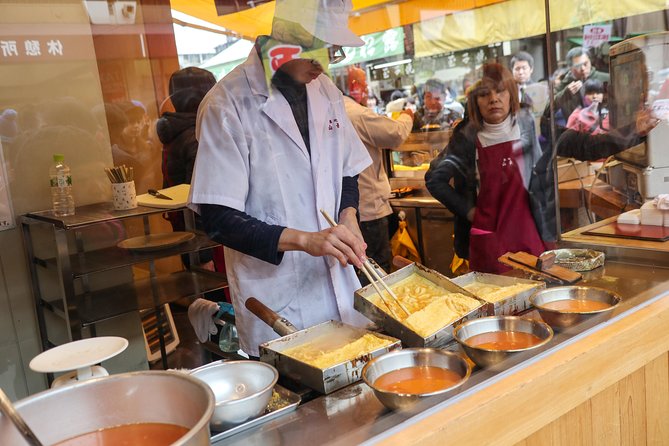
This is where you can pick up classic Japanese seafood snack formats. In past tastings connected to this tour style, people have mentioned things like tamagoyaki, tuna nigiri sushi, unagi (eel) BBQ, scallops on a stick, and more. You should treat those as examples of what the tasting can include, not a guaranteed list for every day.
Why this stop works at the end of a tour: by the time you reach it, you already understand the rhythm of the market. You know what you like, you know what texture you’re craving, and you are less likely to freeze when you see too many choices.
Shrines, temple steps, and why it pairs so well with food
Food tours often treat culture like decoration. This one treats it like part of the story.
Because Tsukiji has both Buddhist temple and Shinto shrine connections, you get a chance to understand why the market neighborhood includes sacred spaces in the first place. You are not just eating seafood. You are walking through a place where belief and daily commerce overlap.
Even the timing helps. You spend the earlier part focused on taste and senses, then you shift into a slower, more reflective section at shrines and temple areas. It is a change of pace that makes the whole experience feel more grounded.
If you enjoy Japanese culture beyond sushi alone, this is one of the stronger points of the tour.
What to expect from the guide (and why guide quality matters)
This tour is a small-group walking experience, and that means the guide’s style affects your day. A lot of the praise centers on guides who are fun, quick to explain what you are eating, and good at steering you through the market without wasted time.
You might be paired with guides such as Hitomi, Mark, Yuki, Tiger, Kazu, or Mia and Mummy, names that have come up in past guest feedback. The good news is that the role is central here, so when the guide is on form, the tour feels like you are getting the market’s shortcuts and story at the same time.
If you care about details, ask questions early. In a market setting, you can lose facts if you stay quiet and just eat. A short question like what you are tasting, or why this stall is a good stop, can turn a snack into a mini lesson.
Allergy, vegan, and substitution reality (read this before you plan)
Here is the clear part: the tour cannot guarantee allergy-free meals or handle dietary restrictions in a way that will fully protect you. Food is prepared in kitchens that do not belong to the tour operator, and substitutions are not guaranteed at every stop.
Vegan options are not available.
That does not mean you are out of luck if you have restrictions. It does mean you should plan realistically:
- Decide if your diet needs are flexible enough to handle possible substitutions
- Do not assume every item can be swapped
- If you have a serious allergy, treat this as a “confirm before you rely” kind of experience, not a risk-free guarantee
The upside is that some guides have shown extra effort for dietary needs in past experiences, including at least one coeliac-related request. Still, the official policy is about not being able to guarantee allergy safety. Your best strategy is to go in informed and prepared.
Who this tour suits best, and who should skip it
Best fit:
- You love seafood and want multiple tastings without hunting on your own
- You want a Tokyo morning that mixes food with Japanese shrine and temple culture
- You prefer small-group walking, not a huge crowd march
- You want an included lunch, so your day has structure
Not ideal if:
- You expect to see the inner wholesale auctions, since the inner market moved to Toyosu
- You are vegan, because vegan options are not available
- You need strict allergy-safe dining, because allergy-free cooking cannot be guaranteed
- You dislike dense walking and tight lanes, because Tsukiji streets require comfort with crowds and movement
Should you book Tsukiji Fish Market Small-Group Food Walking Tour?
I think it is a strong booking if your goal is a guided food walk plus a culture add-on, and you understand you are experiencing the Outer Market ecosystem, not the old inner auction floor.
Book it if:
- You want an included seafood lunch and several sampling stops in about 3 hours
- You like the idea of visiting Buddhist and Shinto sites while you snack
- You value small group size and a route that reduces decision fatigue
Skip or rethink if:
- You are vegan, or you need strict allergy guarantees
- You came for a very specific kind of inner wholesale market viewing
My practical take: wear comfortable shoes, bring water and a hat in summer, and keep your expectations aligned with the Outer Market focus. If you do that, this is one of those Tokyo experiences where you leave full, slightly amused by your own seafood choices, and with a better feel for how markets and belief share space here.
FAQ
Where is the meeting point for the tour?
You meet at Tsukiji Station, Exit 1, and the guide will be waiting there.
How long does the Tsukiji Fish Market small-group tour take?
The tour lasts about 3 hours.
Is lunch included in the tour?
Yes. A fresh seafood lunch is included as part of the experience.
Are vegan options available?
No, vegan options are not available.
Can the tour accommodate allergies or dietary restrictions?
The tour cannot guarantee allergy-free meals or that it can fully accommodate dietary restrictions, since food is prepared in kitchens that do not belong to the tour operator. Substitutions may not be possible at every stop.
Can I cancel for a full refund?
Yes. You can cancel up to 24 hours in advance for a full refund.
Market Mornings We Have Reviewed


Newest Tokyo write-ups from the Loving Japan desk


Tsukiji and Toyosu Fish Markets, side by side.
 ★ 5.0Tokyo Tsukiji Fish Market Food and Culture Walking TourFrom $993,184 reviews
 ★ 5.0Tsukiji Fish Market Food and Walking tourFrom $301,724 reviews
 ★ 4.9Tsukiji Fish Market Guided Walking TourFrom $221,397 reviews
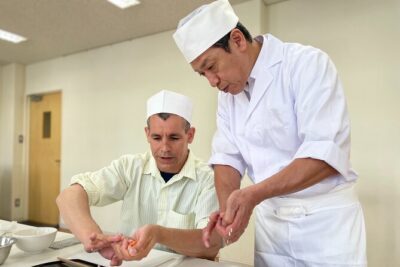 ★ 5.0Tokyo Sushi Making Class in Tsukiji with Professional ChefFrom $491,177 reviews
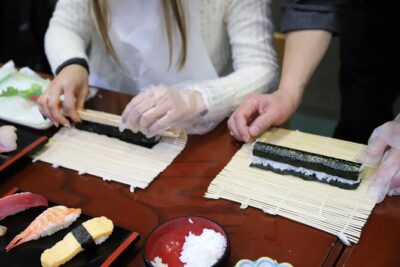 ★ 5.0Tsukiji Fish Market Guided Tour and Sushi Making with Pro ChefFrom $104775 reviews
★ 4.7Tsukiji Fish Market Food and Culture Walking TourFrom $96757 reviews
★ 5.0Tsukiji Fish Market Guided Tour and Sushi Making with Pro ChefFrom $104775 reviews
★ 4.7Tsukiji Fish Market Food and Culture Walking TourFrom $96757 reviews
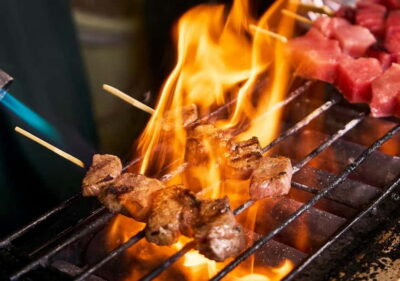 ★ 5.0Tsukiji Fish Market: Street Food & Culture Walking TourFrom $33669 reviews
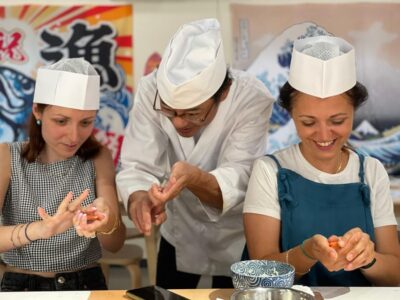 ★ 4.9Tsukiji Fish Market Sushi Making Class with Pro ChefFrom $63506 reviews
Filed on these lists too