
REVIEW · SUMO WRESTLING EXPERIENCES
Sumo Morning Training Watch in Tokyo,Hotel-pickup w/English guide
Waking early for giant athletes resets your day. This Tokyo tour pairs hotel pickup with an English-speaking guide for behind-the-scenes access to pro sumo training at a real stable.
What I like most is the English help that turns rituals and rules into something you can follow, plus the chance to watch serious practice up close. Guides like Hiromi and Koichiro (and others) focused on making the session make sense, not just letting you stare.
One thing to think about: it starts at 7:30am, and you will travel via public transport with some walking. Bring good walking shoes and be ready for an early morning pace.
In This Review
- Key highlights that make this tour work
- Waking Up at 7:30am: What You Gain from a Morning Sumo Session
- Hotel Pickup and the Public-Transit Reality (Bring Your Game)
- Inside a Real Sumo Stable: Exercises, Rituals, and Practice Matches
- Your English Guide Does the Heavy Lifting for You
- Seating Close to the Ring: How the View Works
- The Small Extras: Shrines, Temples, and a Better Read on Local Tokyo
- Price and Value: Why $159.88 Can Be a Smart Deal
- When It Runs (and When It Does Not) in 2025
- Who This Tour Fits Best
- Should You Book? My Practical Take
- FAQ
- What time does the tour start, and how long does it last?
- Is hotel pickup included, and is there hotel drop-off?
- Do I need to speak Japanese?
- What will I do during the training session?
- Is food or drink included?
- How big is the group?
- How should I prepare for getting to the stable?
- What is the cancellation policy?
Key highlights that make this tour work
- Hotel pickup, small group cap (15 max), and a smooth start
- An English-speaking, nationally licensed guide who answers sumo questions
- Real stable access for basic drills, rituals, and practice matches
- Close viewing, with seating options like cushions and sometimes low chairs
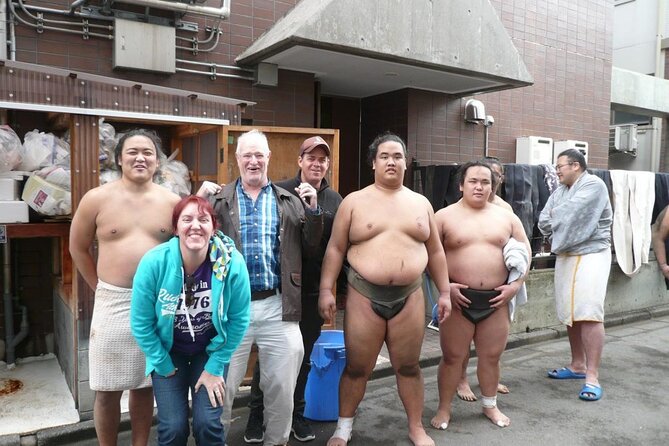
- A photo chance with wrestlers after training, depending on the schedule
Morning practice or an evening show. Both reviewed
- Tokyo: Sumo Show and Dining Experience
★ 4.8 · 2,742 reviews - the SUMO show
★ 5.0 · 1,960 reviews - Tokyo Shinjuku Sumo Show & Experience with Photo
★ 5.0 · 1,750 reviews - Tokyo: Sumo Show and Experience in Shinjuku
★ 4.8 · 1,001 reviews
Waking Up at 7:30am: What You Gain from a Morning Sumo Session
A sumo stable feels different in the morning. The pace is focused. The whole environment is built around repetition, discipline, and getting ready for tournament life.
This tour runs about 3 hours, starting at 7:30am. That timing matters because you are catching the wrestlers during training, not after the day turns into the usual Tokyo rush.
Hotel Pickup and the Public-Transit Reality (Bring Your Game)
The big win is hotel pickup. It saves you from the usual headache of finding the stable, matching train lines, and trying to explain where you are going in the morning rush.
A few practical notes that came up again and again: the route to the stable can include foot and subway, so you’ll want an IC card like Suica (or another compatible card) and comfortable shoes. Also, the stable can be hard to find without a guide, so arriving with the group is part of the value.
You should know one more logistics point: the tour includes pickup, but hotel drop-off is not included. In practice, that means you will plan your return after the tour using nearby transport.
Inside a Real Sumo Stable: Exercises, Rituals, and Practice Matches
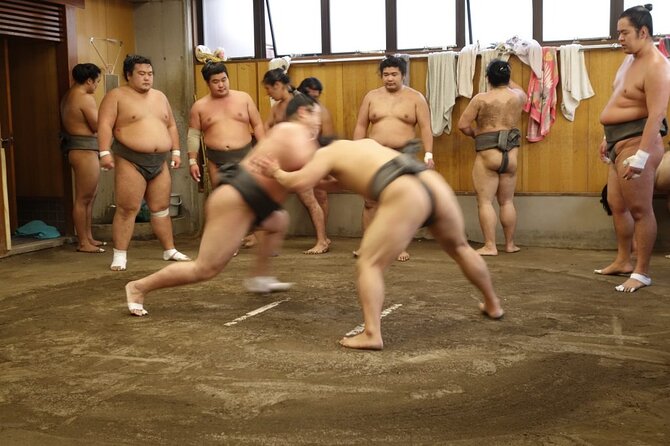
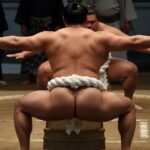
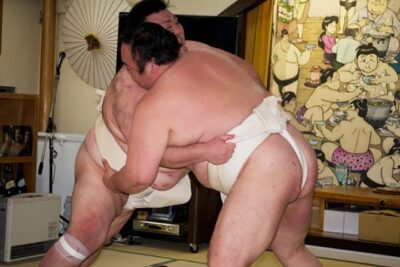
This is not a museum-style show. You are entering an actual sumo stable environment and watching pro wrestlers train in their own space.
Your session typically follows a structure like this:
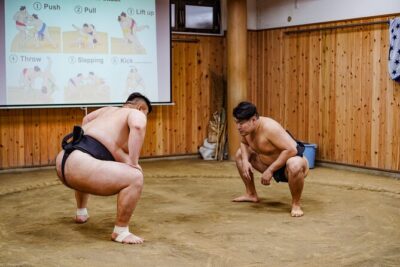
1) Basic sumo exercises
You will see drills meant to strengthen legs, hips, and upper body. Think conditioning plus technique work that builds power for the ring.
2) Serious practice matches
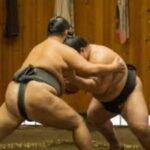
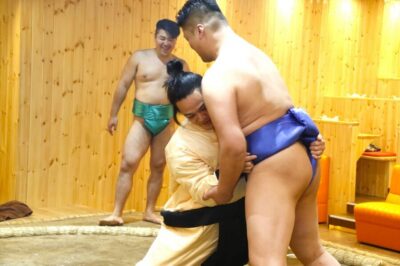
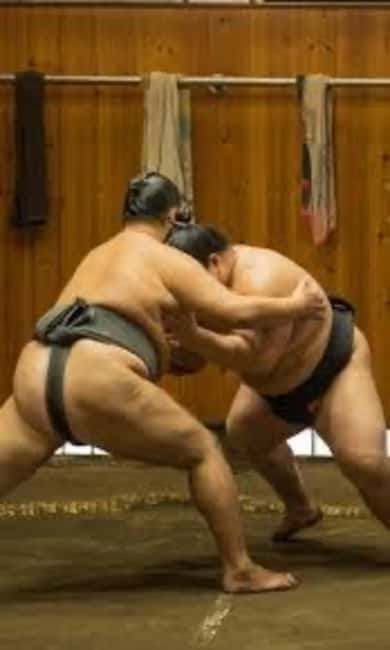
This is the part most people come for. Two wrestlers work a bout at a time, with enough intensity to remind you these are athletes, not characters. You may also notice other wrestlers stretching and doing drills around the ring while matches happen.
3) After-session photo time (schedule dependent)
Depending on the stable and the exact session, you might get a chance to take photos with the wrestlers after training.
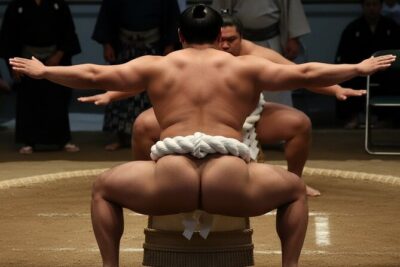
Also pay attention to the “how,” not just the “what.” In the stable, you usually need to keep quiet while the wrestlers train. That restraint is part of the atmosphere, and it also makes your guide’s explanations after the training feel more valuable.
- Mt Fuji and Hakone 1-Day Bus Tour Return by Bullet Train★ 5.0 · 26,383 reviews
- 1-Day Tokyo Bus Tour★ 5.0 · 14,250 reviews
- Tokyo: teamLab Planets TOKYO Digital Art Museum Entry Ticket★ 4.6 · 9,779 reviews
- Mt Fuji & Hakone Cruise, Drum Show Bullet Train 1 Day from Tokyo★ 4.0 · 7,413 reviews
- Tokyo: Shinjuku Food Tour (13 Dishes at 4 Local Eateries)★ 5.0 · 6,603 reviews
Your English Guide Does the Heavy Lifting for You
The difference between watching sumo on TV and watching it live is context. A good guide helps you connect names, rules, and small details to what your eyes are seeing.
This tour is led by an English-speaking guide, and the focus is on helping you understand:
- the traditions and history behind sumo
- the rules and structure you are seeing during training
- what specific actions mean inside the stable
Some guides use handouts and notes so you can follow along while you watch. In at least one case, questions could be handled in a way that keeps things respectful and quiet during training, such as writing notes or using a simple communication method.
If you want to ask questions, this tour is built for it. You get time to learn during the session, and there is usually a moment after training to talk things through.
Seating Close to the Ring: How the View Works
You do not watch from a distant balcony. The whole point is proximity.
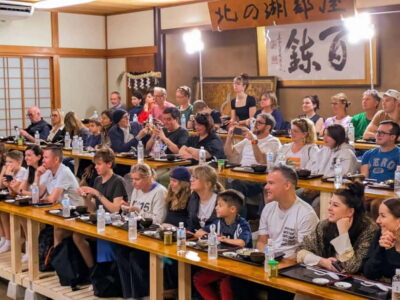
You can expect seating very near the ring, often on cushions. Some stables can also bring in chairs, and those chairs may be low, so getting up can feel awkward if you are not used to low seating.
What you should take from this: close seating makes the experience more physical. You see footwork and balance. You can also hear the impact of practice, which surprises a lot of first-timers.
The Small Extras: Shrines, Temples, and a Better Read on Local Tokyo
The official promise is sumo training at a stable with explanation and pickup. But some routes include small cultural stops en route.
You might pass a shrine on the way, or see a short detour that gives you a bit more texture of local life. People have also mentioned a quick temple visit on the return side, depending on the guide and the day’s routing.
These extras are not the main event, but they make the morning feel like more than just a transfer to a training ring. You end with a better sense of where sumo fits into everyday Japanese culture.
Price and Value: Why $159.88 Can Be a Smart Deal
At $159.88 per person, the price feels steep if you compare it to generic sightseeing. But you are buying three specific things at once:
1) A real stable visit
Not just a performance. You get access to a training environment.
2) Hotel pickup plus guided interpretation
Finding the stable on your own can be a chore. The guide reduces stress and improves the quality of what you see.
3) An English-speaking explanation of rules, rituals, and technique
Sumo is not complicated, but it is loaded with meaning. Having someone translate the why behind the actions is a big part of the value.
The tour also keeps groups small, with a maximum of 15 people. That typically means you get attention, not just a mass of headsets.
One more value clue: this tour often gets booked ahead. An average booking window of about 57 days is a sign that the early slots can fill up.
When It Runs (and When It Does Not) in 2025
This program is not available on these 2025 date ranges:
- May 10 to June 5
- June 26 to August 6
- September 13 to October 8
- October 23 to December 3
If your dates overlap, you will need an alternate tour or a different time window in Japan. It is a good idea to check availability early, especially if you want a specific week.
Who This Tour Fits Best
This is a strong match if you:
- want a true sumo stable experience instead of a generic show
- like sports but also enjoy learning the cultural context
- value English guidance so you do not miss what matters
- want the convenience of hotel pickup and small-group pacing
It may not be ideal if you hate early mornings. The whole setup assumes you are ready to start at 7:30am and move through public transit without much fussing.
It can also be a little demanding in comfort terms because you may sit low on cushions or low chairs, and you might walk part of the route. If that is an issue, plan accordingly.
Should You Book? My Practical Take
I think you should book this if your goal is simple: see pro wrestlers training close up, understand what you are watching, and avoid the logistics puzzle. The English guide, the real-stable access, and the chance for photos after training are the big reasons people love it.
If your dates fall into the 2025 blackout periods, or if early mornings and some walking sound miserable, look for an alternate sumo experience that fits your schedule. Otherwise, this one is hard to beat for value and authenticity in Tokyo.
FAQ
What time does the tour start, and how long does it last?
The start time is 7:30am, and the duration is about 3 hours.
Is hotel pickup included, and is there hotel drop-off?
Hotel pickup is included. Hotel drop-off is not included.
Do I need to speak Japanese?
No. You will have a nationally-licensed English speaking guide.
What will I do during the training session?
You will watch sumo training at an authentic stable. The session can include basic exercises, practice matches, and sometimes a chance for photos with the wrestlers after training, depending on the schedule.
Is food or drink included?
No. Any food & drink are not included.
How big is the group?
The tour has a maximum of 15 travelers.
How should I prepare for getting to the stable?
The stable is reached using near public transportation, and some routes can involve walking and subway. Having an IC card like Suica and wearing good walking shoes can help.
What is the cancellation policy?
You can cancel for a full refund up to 24 hours before the experience starts. If you cancel less than 24 hours before the start time, the amount paid is not refunded.
Practice Rooms and Show Nights

Newest Tokyo write-ups from the Loving Japan desk


Sumo Wrestling Experiences, side by side.
 ★ 4.8Sumo Show Experience with Chicken Hot Pot and a PhotoFrom $1036,678 reviews
 ★ 4.8Sumo Show and Dining ExperienceFrom $792,742 reviews
 ★ 5.0the SUMO showFrom $891,960 reviews
 ★ 5.0Tokyo Shinjuku Sumo Show & Experience with PhotoFrom $791,750 reviews
 ★ 4.8Sumo Show and Experience in ShinjukuFrom $691,001 reviews
 ★ 4.6Sumo Tournament Tour with Chair Seat TicketsFrom $141753 reviews
 ★ 4.5Sumo Show & Experience w/ Optional Kimono & Hot PotFrom $77609 reviews
 ★ 5.0Authentic Sumo Experience in Tokyo: Enter the SanctuaryFrom $171603 reviews
Filed on these lists too