
REVIEW · GION, GEISHA AND MAIKO EXPERIENCES
Kyoto: Lunch or Dinner with Maiko
Maiko are Kyoto in motion. This 90-minute Maiko lunch or dinner turns a meal into a performance, with a Q&A that actually explains daily life, plus two dances you can watch up close while you eat Kyoto classics.
I especially like the personal attention, including time for a commemorative photo right beside the Maiko and a small gift called a Senjyafuda. My only real concern is that the venue is not a traditional tearoom setting, so if you are chasing maximum atmosphere and decor, you may find it a bit more straightforward than you hoped.
In This Review
- Key highlights worth your attention
- Why this Maiko Dinner in Kyoto feels different than a show
- The 90-minute flow: tea demo, dinner, Q&A, then dance
- Kyoto food on the table: dashi, tradition, and shidashi
- Meeting Maiko up close: photo time, Senjyafuda, and Q&A
- Tea ceremony option: when paying extra makes sense
- Seating choices, English support, and small differences in comfort
- Practical stuff that can make or break your experience
- Is it worth $63? Value math for a Kyoto Maiko program
- Who should book this, and who should skip it
- FAQ
- Where is the meeting point?
- How long is the experience?
- What is included in the price for lunch or dinner?
- Is the tea ceremony included, and can I add tea making?
- Are there seating upgrades?
- Is it accessible by elevator and is English available?
Key highlights worth your attention
- Close photo time with the Maiko, plus a Senjyafuda lucky charm
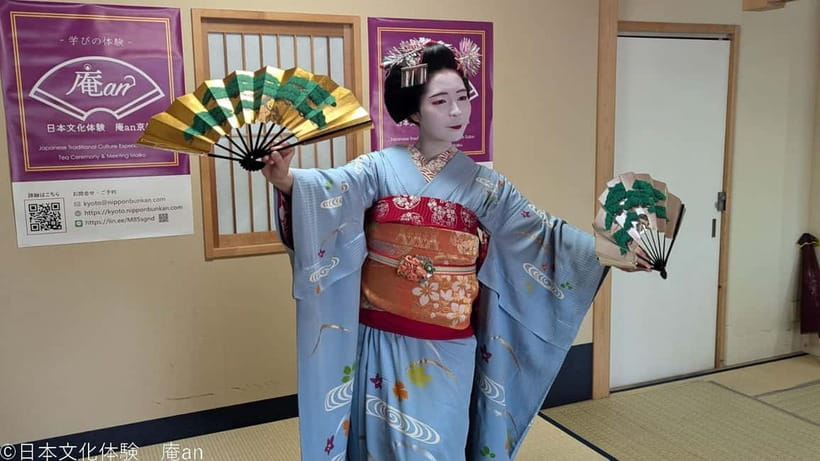
- Two elegant dances that connect to seasons, love stories, and everyday life
- Tea ceremony moments (demo, with an option to add hands-on tea making)
- A real Q&A session where you can ask about routines and what the role involves
- Interactive fun during a simple game, where your claps matter
Evening walks through the old quarters, compared
- Kyoto Geisha Walking Tour: Gion District & Hidden Gems
★ 4.7 · 3,273 reviews - Kyoto: Gion Magical Night Walking Tour with Geisha Trivia
★ 4.9 · 2,393 reviews - Kyoto: Gion Geisha District Walking Tour – Stories of Geisha
★ 4.7 · 2,187 reviews - Best of Kyoto: Gion, Geisha, Pagodas & Cobblestones
★ 4.9 · 2,058 reviews
Why this Maiko Dinner in Kyoto feels different than a show
This is not just a sit, watch, and leave kind of evening. The structure is built around meeting a Maiko as a person first, then experiencing the art second, starting with tea ceremony etiquette and shifting into dance and games.
What makes it work is the mix of formats: you get a demonstration, conversation, food, and performance in one compact block. That matters in Kyoto, where many experiences are either very formal or very distant. Here, you are pulled closer, and you stay close long enough to feel like you learned something, not just watched a routine.
Price-wise, it lands around $63 per person for lunch or dinner. That is not cheap, but you are paying for a full cultural program that includes dinner and multiple stages of access, including photo time and a lucky charm.
The 90-minute flow: tea demo, dinner, Q&A, then dance
Here is what the experience typically follows, in a smooth sequence that runs about 90 minutes total.
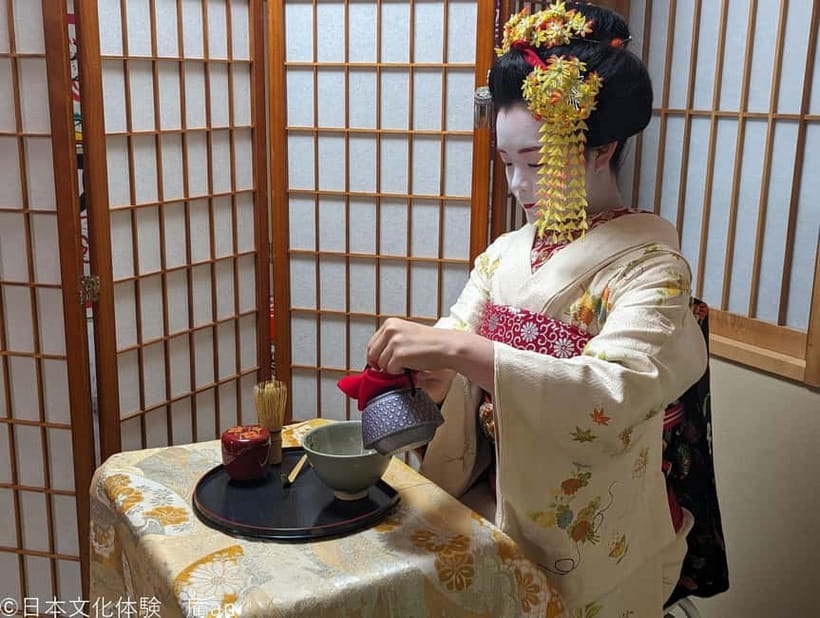
First, there is a tea ceremony demonstration by the Maiko. Even if you do not add hands-on tea making, you get to observe the graceful movements and how etiquette matters in every step.
Next comes dinner prepared by a long-established Kyoto restaurant. You will eat traditional dishes while you are still in the same cultural rhythm of ceremony and attention to detail.
Then the program pivots into a Q&A session. This is where the experience becomes more than entertainment. You can ask questions directly and get insight into daily life and what dedication to tradition looks like in practice.
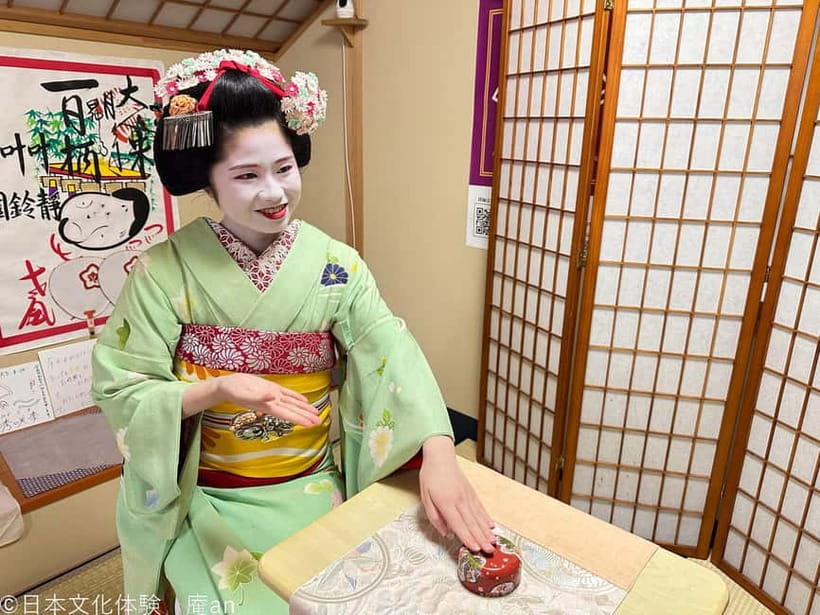
After Q&A, you get a photo opportunity right beside the Maiko. As a special gift, she presents a Senjyafuda, a lucky charm you take home.
Finally, the centerpiece: Maiko dance performance. You see two traditional dances, each expressing themes tied to seasons, love stories, or everyday life, using elegant movement and strong control.
There is also an interactive game with the Maiko as part of the hospitality. If you are willing to cheer, clap, and participate, it turns the whole room into one shared moment, not a passive audience line.
Kyoto food on the table: dashi, tradition, and shidashi
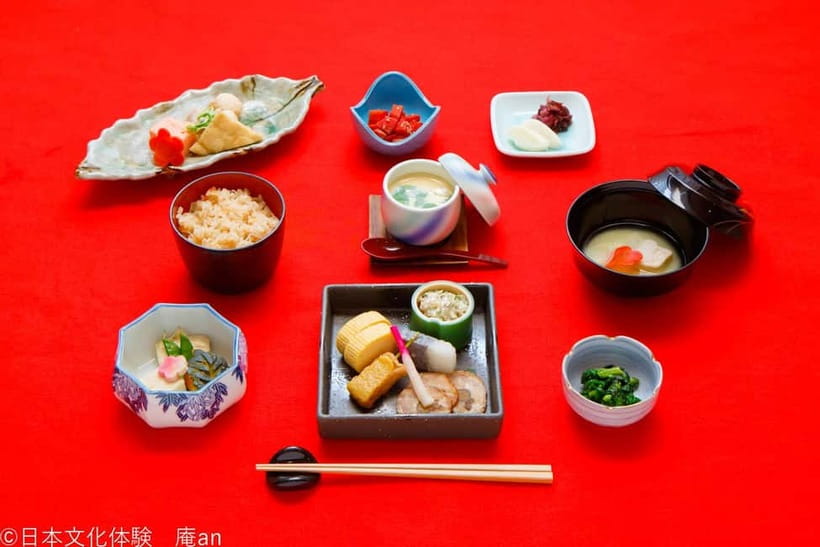
Dinner is not trying to be fancy-modern. The focus is on Kyoto-style tradition, where dashi, the soup stock, shows up again and again. If you like flavors that are gentle, layered, and built on stock-based depth, this fits the bill.
You are also working within a very Kyoto way of serving: delivery and a traditional flow are common. The program uses the local term shidashi, which basically means the food arrives in a customary, service-friendly way rather than being cooked to order in front of you.
The menu details are not listed here, so I cannot promise every dish you will get. But I can tell you what the cuisine style emphasizes, and why it matters: dashi creates a consistent base that ties Kyoto dishes together, even when the plates vary.
One caution from real-world experience, though: not everyone loves how the meal tastes or how it is presented, especially if you are picky about texture, heat, or the look of the serving setup. If you are coming mainly for Maiko dance and conversation, you will probably be happier. If your top priority is a meal that feels restaurant-grade from start to finish, expect the dinner to be good, but not necessarily life-changing.
- PERFECT KYOTO 1-Day Bus Tour★ 5.0 · 13,518 reviews
- Kyoto: Fushimi Inari, Kinkakuji, Bamboo Grove 1 Day Bus Tour★ 4.8 · 4,316 reviews
- Kyoto: Tea Ceremony in a Traditional Tea House in Kiyomizu★ 4.9 · 3,519 reviews
- Kyoto Geisha Walking Tour: Gion District & Hidden Gems★ 4.7 · 3,273 reviews
- Kyoto: Tea Ceremony Ju-An at Jotokuji Temple★ 4.9 · 3,207 reviews
Meeting Maiko up close: photo time, Senjyafuda, and Q&A
This program earns its name by giving you proximity. The photo is not a distant angle or a quick wave. You get time right beside the Maiko for a commemorative picture, and you leave with a small personal gift: the Senjyafuda lucky charm.
The Q&A is also the part you should lean into. Asking questions is not just for curiosity, it helps you understand what you are seeing when she later dances. If you learn how routines connect to discipline, you start noticing details in the performance, like how movements link together and how etiquette shows up in posture.
If you want the tea ceremony portion to mean more, this is the time to ask about what you should watch for. Even without hands-on making, you can pay attention to how she handles the process.
A nice bonus is that the program can change depending on the situation. In some cases, you may be invited with a Geiko instead of a Maiko. That means your experience may feel slightly different, even though the core program style stays the same.
Tea ceremony option: when paying extra makes sense
Tea ceremony is built into the flow as a demonstration. If you want more involvement, you can add the tea ceremony option for 1,600 JPY.
There is also mention of an option to make your own tea. If that is your goal, plan ahead and contact them to add the making-tea part.
So when does the extra cost make sense? If you already enjoy tea culture and want the body-level feel of doing it, it can be worth it. If you are there for dance and the Maiko conversation, you may be fine with the demonstration only, especially since the whole program is only 90 minutes.
If you choose to upgrade seating (more on that next), combining better seating with the tea option can also help. You will be watching movements throughout, and better sightlines can make the experience feel more complete.
Seating choices, English support, and small differences in comfort
Seat upgrades are offered for extra cost:
- SS seat (first row): 3,300 JPY
- S2 seat (second row): 2,200 JPY
- S3 seat (third row): 1,100 JPY
If you are sensitive to sightlines, I would take this seriously. Dance looks best when you can see hands, face, and timing clearly, not just the overall stage shape.
Language support is also worth planning around. Japanese is the main language, and English translation is provided as much as possible. If you want to maximize understanding, ask for help aligning questions for the Q&A.
Also note one physical detail that can affect your comfort: there is no elevator in the building. You will need stairs to reach the venues. This is not a deal-breaker for most people, but it matters if you travel with limited mobility or you have heavy bags.
Practical stuff that can make or break your experience
You meet about a one-minute walk from Exit 1 of Subway Karasuma Line Gojo Station. The store entrance faces Gojo-dori, and that simple landmark helps you arrive calm, not rushed.
Operating hours are 10:00 to 17:00. If a reservation comes in after 17:00, it gets processed the next day.
Timing matters here. The event is not able to accommodate delays, so if you are traveling from another part of Kyoto, build in buffer time. In a program this compact, being late can throw off the whole flow.
One more rule that keeps things moving: if you do not participate in the experience, you will not be allowed to enter. It is a full program space, not a drop-in viewing area.
If you are traveling with kids, children under 2 are free if they sit on a parent’s lap. If a child needs a seat or meal, the same fee as one person applies.
Is it worth $63? Value math for a Kyoto Maiko program
At around $63 per person, you are not paying for just a show. The included items are dinner with a Maiko and the full cultural program with tea ceremony demonstration, Q&A, photo time, Senjyafuda gift, and a dance performance, plus an interactive game.
That means your cost covers multiple formats, not one. In Kyoto, access to a Maiko setting is exactly the kind of thing that gets expensive fast when it is separate tickets for separate moments.
Where the value question gets tricky is the dinner. The cuisine is described as traditional, with dashi and Kyoto-style serving. But the way meals are executed can vary in how satisfying they feel in a modern room. If you are the type who can be flexible and focus on the cultural experience, the package feels like a good deal. If you want a premium meal as the main event, consider booking only if you are comfortable with the food being supportive rather than the star.
Who should book this, and who should skip it
Book this if you want:
- Close access to a Maiko through Q&A and photo time
- Two dances with clear themes, not just one short performance
- A compact 90-minute cultural program that works well even on a busy Kyoto day
- Tea ceremony etiquette as a starting point, then dance as the finale
Consider skipping or adjusting your expectations if:
- Your top priority is a high-end dining experience with dramatic ambiance
- You strongly prefer a traditional tearoom atmosphere, because this takes place in a building and is described as relaxed rather than a classic ochaya setting
This program is also a good fit for people who like learning while they watch. The Q&A turns the experience into something you can carry with you, and it helps the dances make more sense.
Should you book this Maiko dinner program in Kyoto?
If you want an experience that mixes Kyoto food with Maiko performance and real conversation, I think it is a smart pick. Pay attention to seating if you care about visibility, and treat dinner as part of the cultural flow rather than the main reason you came.
If you are chasing atmosphere first and food second, you may want to balance your schedule with something more focused on ambiance. But if you want a close, respectful look at tradition in motion, this is one of the more direct ways to do it in Kyoto.
FAQ
Where is the meeting point?
You meet about a one-minute walk from Exit 1 of Subway Karasuma Line Gojo Station. The store entrance faces Gojo-dori.
How long is the experience?
The program runs about 90 minutes total.
What is included in the price for lunch or dinner?
The included items are dinner with a Maiko and the cultural program elements, such as the tea ceremony demonstration, Q&A session, photo opportunity with the Maiko, Senjyafuda gift, dance performance, and the interactive game.
Is the tea ceremony included, and can I add tea making?
A tea ceremony demonstration is part of the program. There is an option to add the tea ceremony experience for 1,600 JPY, and there is also mention of an option to make your own tea if you contact them to add it.
Are there seating upgrades?
Yes. SS seat (first row) is 3,300 JPY, S2 seat (second row) is 2,200 JPY, and S3 seat (third row) is 1,100 JPY.
Is it accessible by elevator and is English available?
The building has no elevator, so you will use stairs. Japanese is used, and English translation is provided as much as possible. If you want additional English help, you are asked to contact them.
Evenings in the Old Quarters



Newest Kyoto write-ups from the Loving Japan desk
Gion, Geisha and Maiko Experiences, side by side.
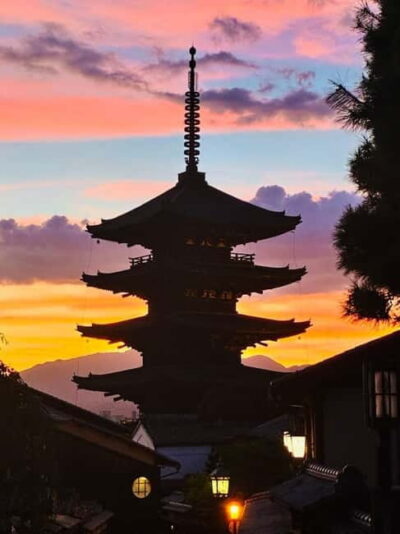 ★ 4.7Kyoto Geisha Walking Tour: Gion District & Hidden GemsFrom $253,273 reviews
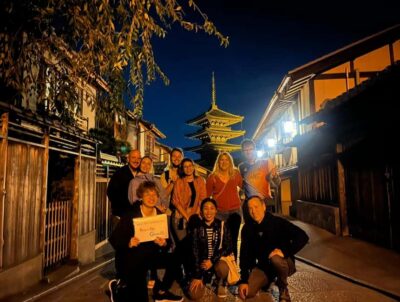 ★ 4.9Gion Magical Night Walking Tour with Geisha TriviaFrom $242,393 reviews
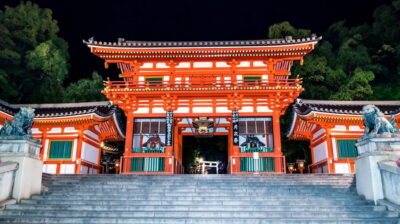 ★ 4.7Gion Geisha District Walking Tour – Stories of GeishaFrom $202,187 reviews
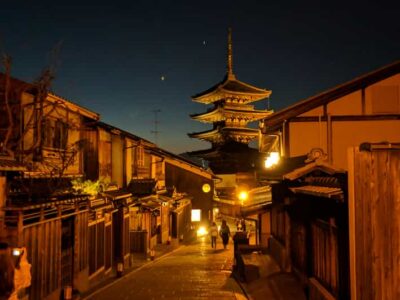 ★ 4.9Best of Kyoto: Gion, Geisha, Pagodas & CobblestonesFrom $242,058 reviews
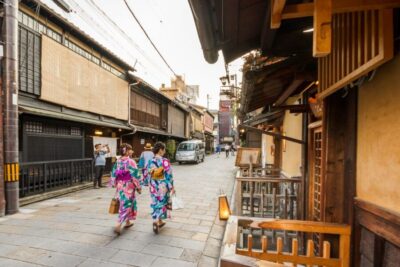 ★ 4.5Night Walk in Gion: Kyoto’s Geisha DistrictFrom $212,003 reviews
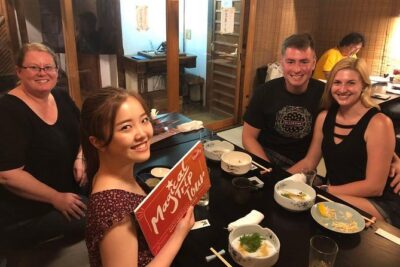 ★ 5.0Kyoto Night Foodie Tour in Gion (9+ dishes + 6 Sake tastings)From $1631,762 reviews
 ★ 5.0Kyoto Gion Geisha District Walking Tour – The Stories of GeishaFrom $251,441 reviews
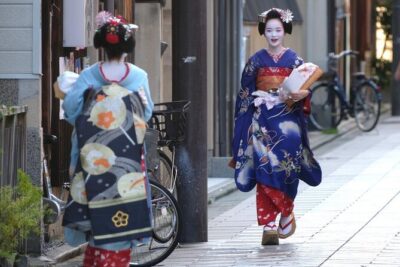 ★ 5.0Kyoto Gion: 2-Hour Geisha Culture & History Walking TourFrom $231,186 reviews
Filed on these lists too