
REVIEW · JAPANESE CRAFT AND CALLIGRAPHY WORKSHOPS
Authentic knife making experience at a blacksmith in Kyoto
You can hammer a Kyoto knife yourself. I love the hands-on forging with instructor Mao, and I love that you leave with a practical, usable knife. The only real drawback is that it is hot and physical work, so you need to show up ready to sweat.
If you want a Kyoto souvenir that is more than a photo prop, this hits the mark. The class is priced at $154 per person for about a 3-hour experience, and your finished blade runs roughly 13 to 15 cm, fully handmade, with packaging included.
In This Review
- Quick hits before you book
- Why Kyoto knife forging beats the usual craft workshop
- Meeting up in Sakyo-ku: stations, studios, and quick planning
- Step by step: check-in, attire, and a safety-first mindset
- The forging moment: heating the steel and hammering the blade
- Cooling, refining, and getting the knife closer to shape
- Sharpening stones and the moment the edge appears
- Polishing and finishing: kurouchi style and the look of handmade
- Location and logistics that affect your day more than you think
- Cost and value: what $154 buys you and why it feels fair
- Who this Kyoto knife making class suits best
- Who should skip or reconsider
- Final verdict: should you book this Kyoto knife making experience?
- FAQ
- How long is the knife making experience?
- What is the price per person?
- Do I take the knife home?
- About how big is the knife you make?
- What is included in the price?
- What should I bring?
- Where is the meeting point, and is it near a station?
- What languages are the instructors?
- Is alcohol allowed?
- What are the age limits?
Quick hits before you book
- You make a take-home knife designed for real everyday use, not just decoration.
- Mao leads the process, and his instruction is built around safe technique and control.
- You forge heated steel at furnace temperatures around 800 to 900 °C, then work it through cooling, shaping, and sharpening.
- You get the whole station setup: costume, towel, water, tools, materials, plus a box and bag for transport.
- Photos and videos are welcome throughout the session, so you can capture the milestones.
- You can end up with a small group, sometimes even very small, which means more hands-on help.
Make something to take home. Other workshops
- Kyoto : Chopsticks Making Workshop in Gion with Engraving Option
★ 5.0 · 958 reviews - Authentic knife making experience at a blacksmith in Kyoto
★ 4.8 · 350 reviews - Kyoto: Calligraphy class at Buddhist temple in city center
★ 5.0 · 167 reviews - Roketsu dyeing experience: M course Roketsu Dyeing Experience
★ 5.0 · 163 reviews
Why Kyoto knife forging beats the usual craft workshop
Kyoto has plenty of traditional crafts, but blacksmithing in the sense of forging steel is rare. This workshop lets you do the part most visitors never get to see, hammering and shaping hot metal into an actual blade.
What makes it feel authentic is that you’re not just watching someone else work. You’re doing the core steps yourself: heat, hammer, cool, refine, sharpen, then polish. The end result is a souvenir you can actually use, which changes the whole vibe. A ceramic cup is nice, sure. A knife you built with your own hands becomes a memory you keep every time you cook.
One more thing I like: the workshop is designed for beginners, but it still treats the process seriously. You’ll get clear tool handling guidance and safety instructions, and you can ask questions throughout.
Meeting up in Sakyo-ku: stations, studios, and quick planning
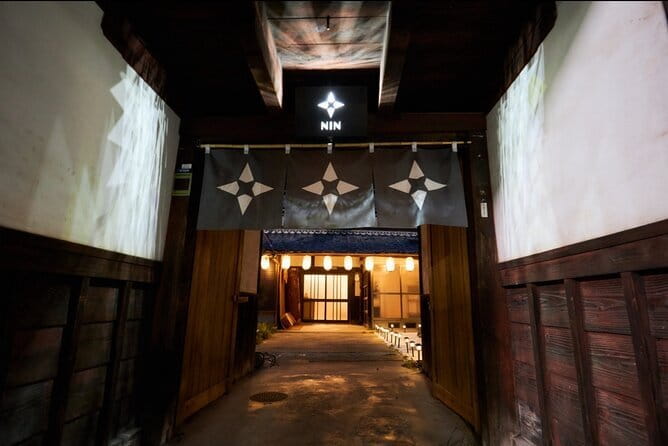
This experience runs out of two studios in Sakyo-ku, Kyoto: Studio NIN Yase and Studio NIN Kendo. You meet at Studio Shinobi YASE (168-1 Yase-no-secho, Sakyo-ku), which is listed as a one-minute walk from the Yase-Hieizan Exit of the Eizan Electric Railway.
Here is the practical catch. Because there are two studio locations, you should pay attention to the message your staff sends before your visit. One studio may be a short walk from the station, while another may take a bit more time to reach depending on how they route you. Plan extra time so you’re not rushing while your socks and nerves are already on.
My advice is simple: take the train if you can. Taxi is available, but the train gets you close fast. Either way, give yourself a little buffer and confirm which studio you are attending.
Step by step: check-in, attire, and a safety-first mindset
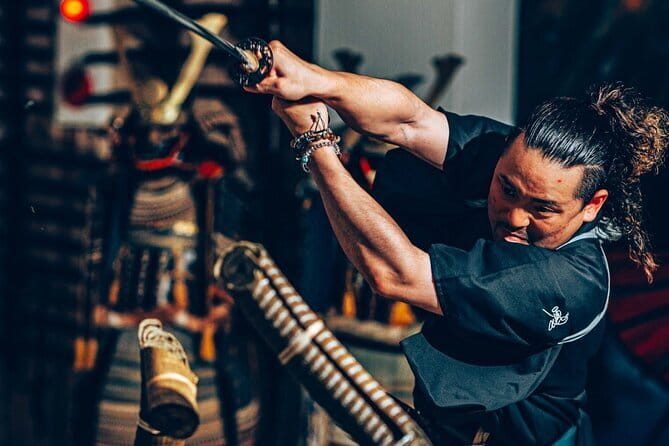
The session starts with check-in at the studio, where you’ll be greeted by the instructor and staff. Mao is the name that comes up most in the workshop context, and the focus is on professional guidance and safe technique.
Then comes the traditional part that you feel right away. You change into the craftsman uniform worn by Japanese smiths. It is not a gimmick. It helps you shift into the right mindset: you are learning a real trade, with real heat and real tools.
After attire, you get a tools and safety introduction. You’ll learn how to handle core blacksmithing tools like hammers and tongs, plus grinders. Even if you’ve never held any of this before, the workshop aims to get you to the point where you can work confidently without guessing.
Important practical note: this is hands-on work that involves danger. In the unlikely event of an injury or accident, the participant is responsible. That sounds scary on paper, but what matters day to day is that you follow instructions closely, keep your body positioned correctly, and treat the workspace like a workshop, not a playground.
- PERFECT KYOTO 1-Day Bus Tour★ 5.0 · 13,518 reviews
- Kyoto: Fushimi Inari, Kinkakuji, Bamboo Grove 1 Day Bus Tour★ 4.8 · 4,316 reviews
- Kyoto: Tea Ceremony in a Traditional Tea House in Kiyomizu★ 4.9 · 3,519 reviews
- Kyoto Geisha Walking Tour: Gion District & Hidden Gems★ 4.7 · 3,273 reviews
- Kyoto: Tea Ceremony Ju-An at Jotokuji Temple★ 4.9 · 3,207 reviews
The forging moment: heating the steel and hammering the blade
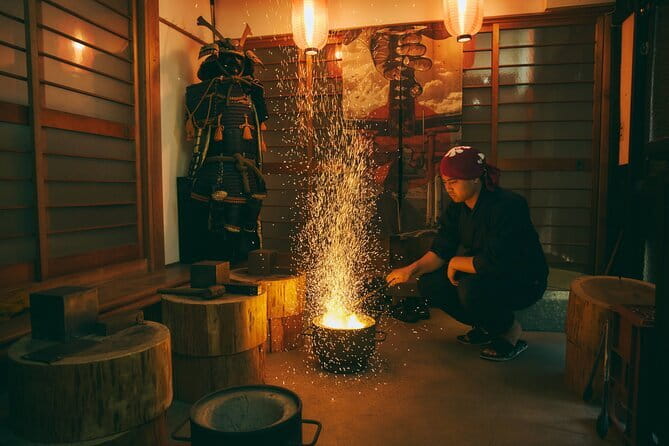
The heart of the experience is forging. You’ll place raw material into a furnace and heat it until it glows red-hot. This is where the workshop becomes unforgettable. The moment you see that metal at temperature, you understand why this craft needs respect.
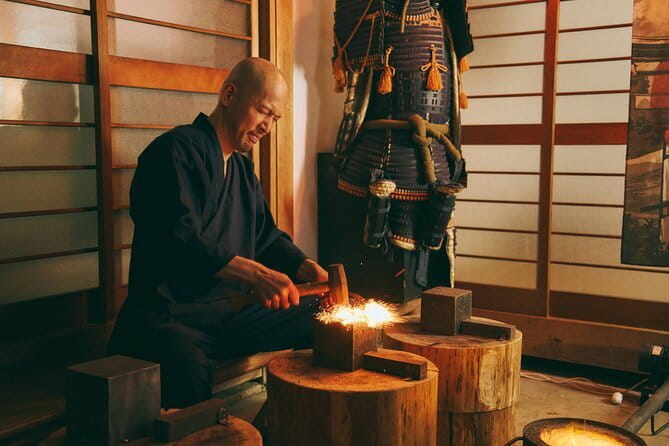
Then you get the highlight: forging the blade by repeatedly striking the glowing steel with a hammer. Mao guides you closely, including details like hammer angle, rhythm, and precision. This is not just random pounding. You’re training your hands to respond to heat, weight, and control.
You might feel a little awkward at first, especially with timing and keeping the work aligned. That’s normal. The instructors are there to correct your posture and technique so you get a real outcome instead of a mangled lump.
The heat is real. One review notes the metal is heated around 800 to 900 °C. That means you’ll feel the workshop environment too, so pacing matters. The staff provides practical help throughout, including guidance on safe handling and cooling down when needed.
Cooling, refining, and getting the knife closer to shape
After forging, the process moves into cooling and refinement. The metal gets cooled and checked for shape. You’ll refine rough edges and prepare the blade for sharpening.
This is a stage many people underestimate. Hammering is dramatic, but the blade becomes what it is through careful refinement. Here you shift from brute force to attention. You’re working toward lines, proportions, and an edge profile that makes sharpening possible.
If you mess up a small detail, you’re not left stranded. The instructors are there to help you correct what they can so your final knife is usable. The goal is for you to take home something you can be proud of, not just a lesson you completed.
Sharpening stones and the moment the edge appears
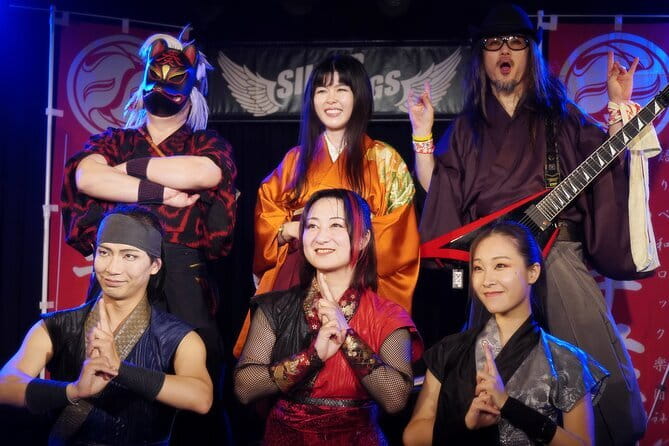
Next comes sharpening. Under expert instruction, you use sharpening stones and grinders to bring the edge to life.
This is where the knife starts to feel real to you as a tool. Before sharpening, it’s mostly shape. After sharpening, you can see the change in how it behaves. It becomes something you can imagine at your kitchen cutting board.
The workshop teaches you in a way that works for beginners. You’re not expected to know grit, angle, or stone technique from memory. You get guidance while you work, and the staff keeps an eye on your progress.
This step also helps you appreciate the skill behind Japanese kitchen knives. It’s not only forging. It’s what happens afterward that creates performance.
Polishing and finishing: kurouchi style and the look of handmade
Once the edge is formed, you polish and apply the final finish. The polishing step turns forged steel into something elegant, not just functional.
Finish details matter. One review specifically mentioned Kurouchi, a rustic rawly forged finish. The point is useful for you: this look is part of the aesthetic, and it can also help with anti-rust characteristics. If you expect everything to come out shiny like supermarket steel, manage your expectations. The charm is that it looks handmade, because it is.
Your finished knife is about 13 to 15 cm long and is fully handmade. You also get a box and bag, so you can pack it right away and keep it protected for travel.
Also, you can typically capture the process. Photos and videos are welcome throughout the session, so you can record the glow stage, the hammering, the sharpening, and the final reveal.
Location and logistics that affect your day more than you think
This workshop is not deep in the middle of Kyoto tourist lanes. It’s in Sakyo-ku, and the meeting point is near public transport. That’s good news, but there’s still one logistics point worth planning for.
There are two studios, and the directions you receive can route you to the correct one. Give yourself extra time to avoid stress. The workshop is physically demanding, so starting late or confused makes the heat and hammering feel harder than it should.
On the plus side, reviews mention the location is conveniently accessible by train, with a short walk involved. The station proximity is a real advantage if you’re also juggling other Kyoto plans, like temples, food stops, and evening strolls.
Cost and value: what $154 buys you and why it feels fair
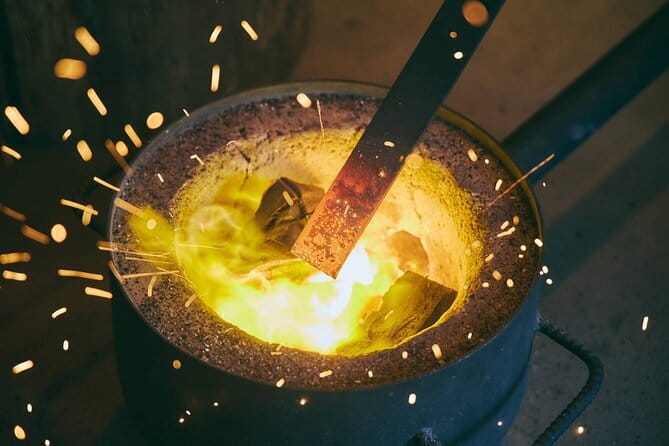
At $154 per person for about 3 hours, you’re paying for more than a souvenir. You’re paying for skilled instruction, equipment, materials, and the full workflow, from furnace to sharpening to finishing.
In other words, the value is in the whole experience, not just the end product. A pre-made knife costs money too, but here you also get the rare part, learning how a blade is shaped and finished in a real workshop.
Packaging is included as well: box and bag. That matters because you’re taking something delicate and potentially sharp home. Costume, towel, water, and tools are included too, so you’re not nickel-and-diming your budget for basic essentials.
One more value note: knife options can change the cost. One review mentioned that adding a handle option may cost extra, for example 5000 yen, paid cash or by card (including Apple Pay). The standard workshop price is clear enough, but if you care about a specific knife style, ask when you arrive.
Also, if you ever see larger knife formats offered, be aware they require more time and cost more, with one note saying larger knives can run over 5 hours and cost more than $400.
Who this Kyoto knife making class suits best
This is best for people who like hands-on learning and want a practical souvenir.
You’ll likely enjoy it if:
- you want something more meaningful than a store-bought gift
- you enjoy physical activities and don’t mind getting hot
- you like structured instruction from professionals
- you cook at home and will actually use a knife
It can also work well for couples and friends. Small group availability means you typically get more attention than you would in a big crowd setting. Some groups in recent sessions were very small, which makes the learning feel personal.
If you travel solo, you can still fit in easily. The activity is social in the way that workshops are social, with instruction and shared progress, and the final knife gives you an easy conversation starter.
Who should skip or reconsider
This is not for everyone.
The workshop is not suitable for:
- children under 15 (and those children must have a guardian)
- people over 95
And if you have concerns about heat, physical effort, or working near hot metal and tools, take that seriously. This is not a passive cultural performance. You will hammer. You will handle tools. You’ll be in a furnace environment.
Also avoid scheduling this on a day where you already feel wiped out. Heat plus repetitive hammering can tax your hands and shoulders even if you’re in good shape.
Final verdict: should you book this Kyoto knife making experience?
If you want a Kyoto experience that feels rare and tangible, I’d book it. You make the knife, you sharpen it, you polish it, and you take it home boxed and bagged. That’s the kind of souvenir that earns its place on your shelf because it earned your time.
You should also book it if you enjoy learning by doing, and you’re okay with a physical, hot workshop environment. The instructors, including Mao, are there to guide you through safe technique, and the session is built so beginners can end with a usable blade.
Just come prepared for effort. Bring socks, take the train if you can, confirm which studio you’re attending, and give yourself a little time buffer. Do that, and you’ll leave Kyoto with a knife and a story you can use every single week.
FAQ
How long is the knife making experience?
The workshop duration is listed as 3 hours.
What is the price per person?
The price is listed as $154 per person.
Do I take the knife home?
Yes. Your finished knife is ready to take home after the session.
About how big is the knife you make?
Your finished knife is about 13 to 15 cm long.
What is included in the price?
Included items are costume, towel, water, tools, materials, box, and bag.
What should I bring?
You should bring socks.
Where is the meeting point, and is it near a station?
The meeting place is Studio Shinobi YASE (168-1 Yase-no-secho, Sakyo-ku, Kyoto City). It is listed as about a one-minute walk from the Yase-Hieizan Exit of the Eizan Electric Railway.
What languages are the instructors?
The instructor supports English and Japanese.
Is alcohol allowed?
No. Alcohol and drugs are not allowed.
What are the age limits?
Children under 15 must be accompanied by a guardian, and the experience is not suitable for people over 95 years.
Made by Hand, and Yours to Keep
Newest Kyoto write-ups from the Loving Japan desk



Japanese Craft and Calligraphy Workshops, side by side.
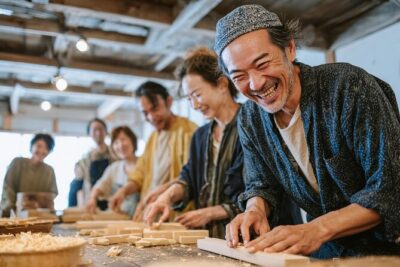 ★ 5.0Tokyo Shinjuku Chopsticks Making ClassFrom $201,763 reviews
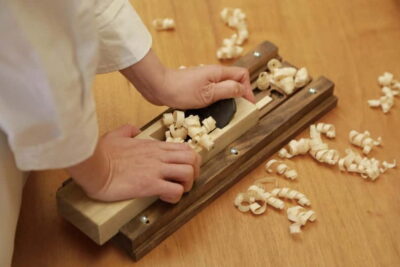 ★ 4.8Chopstick Making Workshop in GinzaFrom $251,366 reviews
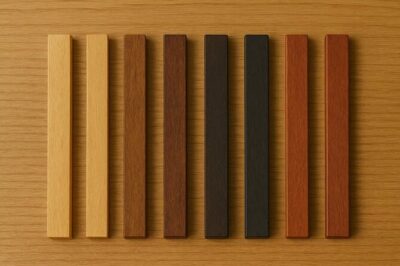 ★ 5.0Chopsticks Making Workshop in Gion with Engraving OptionFrom $15958 reviews
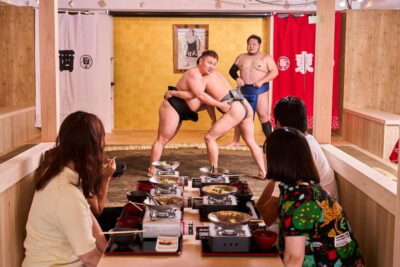 ★ 4.8Tokyo Sumo Experience: Chanko & Mochi with a Former ProFrom $103567 reviews
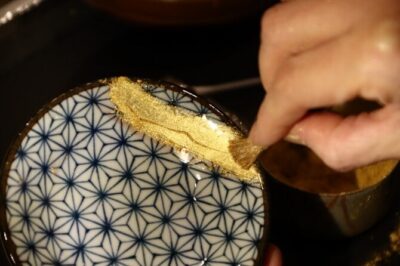 ★ 5.0Kintsugi Experience: Art of Golden Joinery in TokyoFrom $59467 reviews
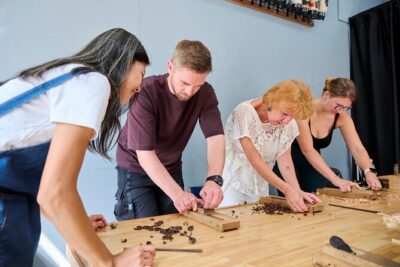 ★ 5.0Tokyo Chopstick Making Workshop with ArtisanFrom $26466 reviews
 ★ 4.9Matcha Making Experience with Mochi Sweets in AsakusaFrom $22388 reviews
 ★ 4.9Traditional Mochi Pounding Experience with TastingFrom $31306 reviews
Filed on these lists too